5 Arrival Checks Labs Must Run on Peptide Packaging for Shipping
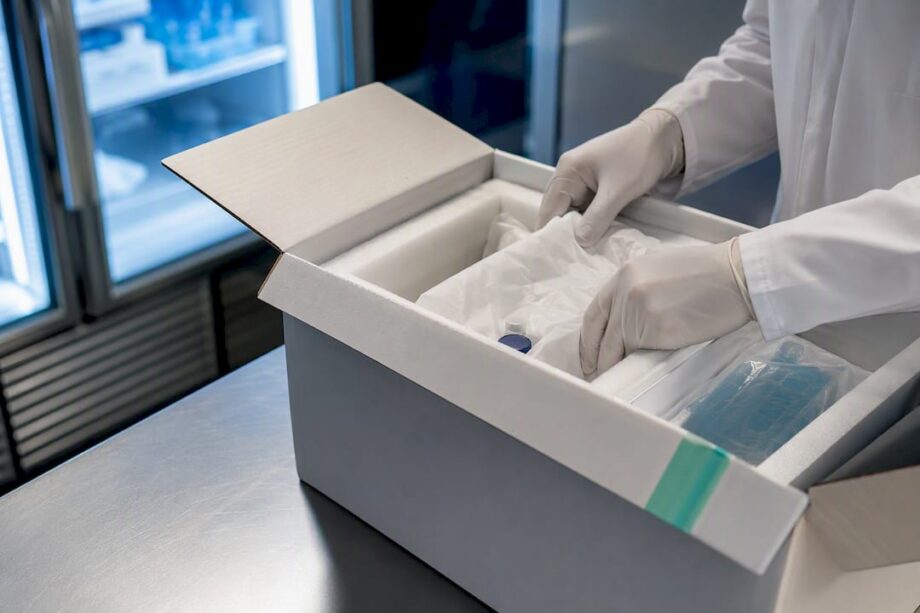
A compliant peptide shipment arrives in an insulated outer container sized to the cooling media inside, with the vial sealed and protected from moisture, a Certificate of Analysis matching the lot number on the label, and clear storage instructions on the packing list. Thermally fragile or high-value orders should also include a temperature indicator or logger. Anything less puts purity, and your data, at risk before the vial ever reaches your bench.
TL;DR:
- Peptides should be shipped in high-quality, moisture-proof containers with clear storage instructions and temperature indicators, especially for fragile or high-value orders.
- Long-distance shipments require insulated packaging with appropriate cooling media, such as phase-change materials or vacuum-insulated panels, to maintain specified temperature ranges.
- Shipping protocols must consider peptide sequence sensitivity, with faster carrier options and built-in cold-chain guarantees to prevent degradation during transit.
- Proper documentation, including matching Certificates of Analysis, safety data sheets, and vendor policies, is crucial for verifying shipment quality and compliance upon arrival.
- After delivery, immediate inspection of packaging integrity, temperature, and documentation is essential, accompanied by a recorded temperature log to support any claims of thermal excursions.
Table of Contents
- Peptide Packaging for Shipping: What Goes in the Box
- Which Temperature Range Does Your Peptide Need in Transit?
- What Documents Should Arrive With Every Peptide Shipment?
- How Should Labs Verify a Peptide Shipment on Arrival?
- Building Cold-Chain Requirements Into Your Purchase Orders
- Regulatory Considerations and Compliance for Shipping Peptides
- What Customs Paperwork Do International Peptide Shipments Need?
- Preventing Damage to Peptide Packaging in Transit
- What Happens When a Peptide Shipment Fails Cold-Chain?
- How Reliable Suppliers Handle Peptide Shipping Standards
- Where to Verify Peptélia’s Packaging and COA Standards
- Sources
Peptide Packaging for Shipping: What Goes in the Box
The vial itself matters more than most procurement checklists admit. Lyophilized peptide should sit in a high-quality glass or polypropylene vial, not a generic plastic tube, because peptides can adsorb onto container walls and lose measurable mass in low-quality plastics. Moisture is the other silent killer. Lyophilized peptides are best stored cold, and contamination with moisture greatly reduces stability even before you factor in temperature.
A properly packaged shipment layers protection around that vial rather than relying on one barrier:
- A sealed secondary bag with desiccant to buffer against humidity during transit
- A tamper-evident cap or seal that shows visibly if the vial has been opened
- Rigid or foam inner packaging that keeps the vial from shifting or striking the container wall
- An insulated outer box, either expanded polystyrene (EPS) or a vacuum-insulated panel (VIP) system
EPS boxes cost roughly $3 to $5 and hold temperature for a limited window. VIP containers run $15 to $30 but extend the cold hold past 72 hours, which matters when a shipment gets stuck at a customs hub over a weekend. Cooling media follows the same logic: gel packs give a wet, gradual cold release; phase-change materials (PCMs) hold a specific target temperature more precisely; dry ice is reserved for shipments that genuinely need to stay frozen, since it can drop well below what most lyophilized peptides tolerate.
Pro Tip: Ask whether the vial sits directly against the cooling element or is buffered from it. Peptides that aren’t rated for freezing can pick up localized cold damage from direct dry ice or frozen gel pack contact, even if the box’s average interior temperature reads fine on paper.
Which Temperature Range Does Your Peptide Need in Transit?
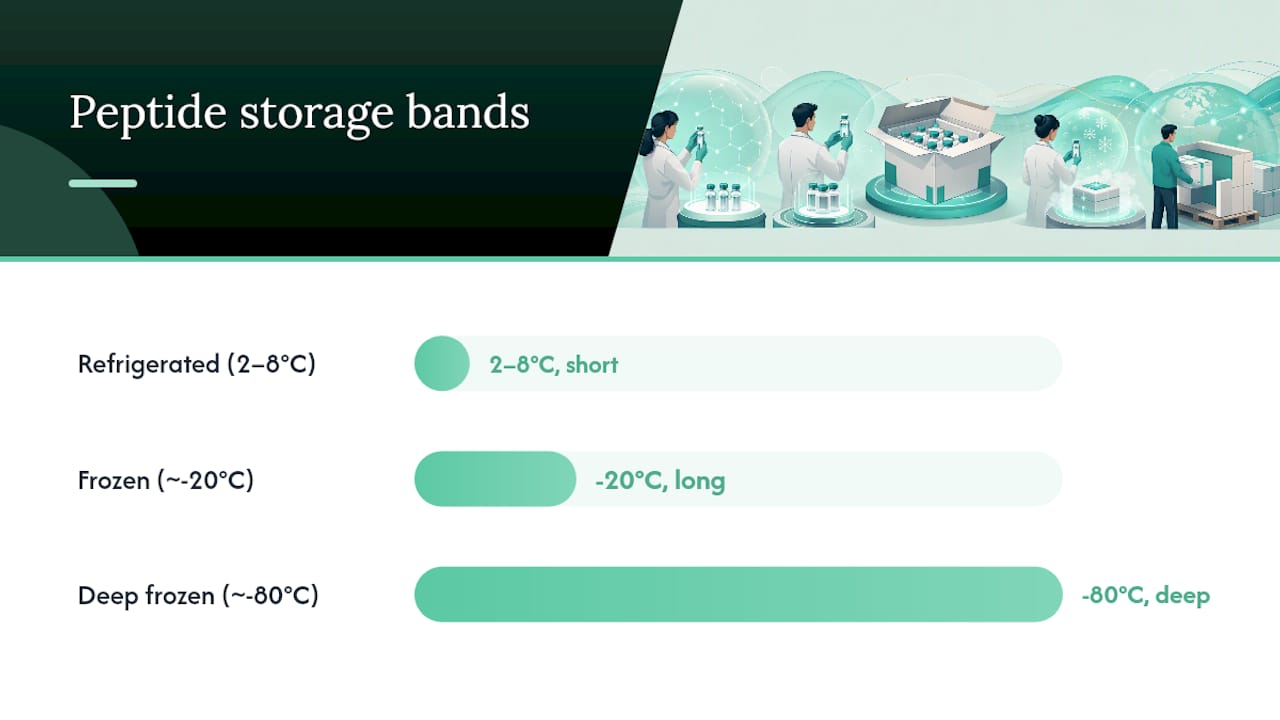
Most research peptides fall into one of three storage bands, and the right shipping setup depends on which one applies. Refrigerated storage (2 to 8°C) covers many reconstituted solutions and some lyophilized products for shorter durations. Frozen storage (around -20°C) is the standard long-term recommendation for lyophilized peptide, and deep frozen (-80°C) applies to a smaller set of especially unstable sequences. For long-term storage, -20°C is preferred over refrigeration, and some suppliers push that further, recommending closed containers below -15°C for extended shelf life, per Bachem’s handling guidelines.
Sequence matters as much as the thermometer. Peptides containing cysteine, methionine, tryptophan, or asparagine and glutamine residues degrade faster through oxidation or deamidation, and that instability compounds with every hour spent at ambient temperature during transit. A peptide with none of those residues might tolerate a delayed shipment reasonably well. One loaded with cysteine and methionine will not.
Sizing the ice budget is where a lot of shipments quietly fail. A standard cooling window for gel packs or PCM runs 48 to 72 hours, so anything routed through slower ground logistics risks running out of cold before it runs out of distance.
Three numbers worth keeping in mind when you’re evaluating a vendor’s shipping method:
- 48 to 72 hours — typical effective cold hold for gel pack or PCM cooling media
- $25 to $40 — approximate cost range for a reusable temperature data logger suitable for high-value shipments
- 72+ hours — hold time achievable with VIP containers versus standard EPS foam.
For anything crossing a border or riding more than a day or two in transit, expedited or next-day carrier service isn’t a luxury add-on. It’s the only way the ice budget and the transit time stay in sync. Ground shipments stretching past 24 to 48 hours are a real liability for thermally fragile compounds, regardless of how good the insulation looks on the outside.
What Documents Should Arrive With Every Peptide Shipment?
Every compliant peptide order should include four categories of paperwork, and a procurement officer should treat their absence as a disqualifying red flag, not a minor omission.
- Certificate of Analysis (COA) stating purity percentage, the assay method used, and a lot number that matches what’s printed on the vial. This is the single document that turns a supplier’s purity claim into something you can actually verify.
- MSDS/SDS covering handling and safety information, packaged alongside a packing list that repeats the lot number and spells out storage instructions in plain language.
- Labeling marking the product “For Research Use Only,” along with a tamper-evident seal and any temperature-handling instructions printed directly on the outer box.
- Vendor policy documentation, meaning a transparent shipping policy and a stated replacement policy that specifically addresses documented thermal excursions, not just lost or damaged parcels.
Fulfillment specialists treat COA, MSDS, and lot-matched packing lists as baseline, non-negotiable inclusions rather than premium add-ons. If a supplier treats them as optional, that’s a signal worth acting on before you place a second order.
How Should Labs Verify a Peptide Shipment on Arrival?
Run these checks the moment a shipment arrives, before the box even makes it to storage:
- Inspect the outer packaging for crushed corners, punctures, or a compromised insulation layer.
- Check the cooling media state. Gel packs should still feel cold, PCM should show no signs of full liquefaction, and dry ice should still be sublimating, not gone entirely. Photograph anything that looks off before you touch the vial.
- Measure the actual temperature with an IR thermometer aimed at the package interior, or pull the file from a data logger if one was included, and compare it against the expected range for that peptide.
- Match the COA and lot number printed on the paperwork against the number on the vial itself. Any mismatch means the shipment gets quarantined, not opened.
- Invoke the replacement policy immediately if temperature, documentation, or physical integrity fails, while the evidence is still fresh and photographed.
Pro Tip: Keep a dated log of every incoming shipment’s measured temperature next to its expected range. A single excursion might be bad luck. A pattern across three or four orders from the same supplier tells you their cold-chain process isn’t reliable, and no amount of apologetic customer service fixes that.
Building Cold-Chain Requirements Into Your Purchase Orders
The checks above work best when they’re written into your procurement language ahead of time, not improvised after a box shows up warm. Build these into every purchase order for temperature-sensitive peptides:
- Require a COA with every order, not just the first one from a new vendor
- Require lot tracking that ties the COA number to the physical vial label
- Require a stated cold-chain guarantee for any compound flagged as thermally fragile
- Require a written replacement policy specifically covering thermal failures, with a defined response window
On acceptance, three criteria decide whether a shipment passes or gets flagged: the insulated package arrived intact, the interior temperature fell within the stated range, and the COA matches the lot number on the vial. Once accepted, let lyophilized vials warm to room temperature before opening to avoid condensation inside the vial, aliquot solutions immediately to avoid repeated freeze-thaw cycles, and move product straight to the storage temperature your COA specifies.
| PO requirement | Why it matters |
|---|---|
| COA with matching lot number | Confirms purity claim ties to the physical product received |
| Cold-chain guarantee clause | Sets vendor accountability for thermally fragile compounds |
| Written replacement policy | Defines recourse before a failure happens, not after |
| Acceptance criteria on file | Gives receiving staff a clear pass/fail standard |
Regulatory Considerations and Compliance for Shipping Peptides
Research peptides shipped internationally by air fall under International Air Transport Association (IATA) dangerous goods and packaging guidance whenever they’re shipped with dry ice, since dry ice itself is classified as a dangerous good due to the carbon dioxide gas it releases as it sublimates. Any shipment using dry ice as a coolant needs proper UN-rated packaging, correct quantity documentation, and carrier-specific dry ice declarations, which is one more reason gel packs or PCM are often the simpler compliant choice for shipments that don’t strictly need sub-zero freezing.
Within the United States, the Department of Transportation (DOT) governs ground and air transport of dry ice and certain packaging materials under hazardous materials regulations, separate from any restrictions on the peptide compound itself. Peptides sold explicitly for research use, not for human consumption, generally move under different customs and transport categories than pharmaceutical-grade material, but that distinction depends entirely on accurate labeling and documentation matching the product’s actual use classification.
Cross-border shipments add another layer: destination countries can apply their own import restrictions on research chemicals, and a shipment lacking a proper commercial invoice, product description, or safety data sheet is far more likely to sit in a customs hold, which defeats the entire purpose of a carefully sized cold-chain package. Procurement teams working with international suppliers should ask directly how the vendor classifies shipments for transport purposes and whether their packaging has been reviewed against current carrier and import requirements, rather than assuming compliance because a shipment arrived without incident once before.
What Customs Paperwork Do International Peptide Shipments Need?
Customs clearance for a peptide shipment hinges on paperwork accuracy, not just packaging quality. A commercial invoice needs an accurate product description, quantity, declared value, and the correct harmonized tariff code for research chemicals, since a vague or mismatched description is one of the most common reasons customs holds a package for manual review.
Alongside the invoice, customs officials typically expect a packing list, the Certificate of Analysis, and a safety data sheet that together confirm what’s actually inside the box. A shipment labeled “For Research Use Only” should carry documentation that consistently reflects that classification. Any inconsistency between the product label, the invoice description, and the COA is exactly the kind of red flag that triggers extended inspection, and every extra hour in an unrefrigerated customs holding area works against the peptide’s stability.
Institutional buyers importing on a recurring basis benefit from establishing a consistent import process with their supplier rather than treating each shipment as a one-off event. That means confirming in advance which party handles customs paperwork, whether the price already reflects duties and clearance fees, and how the supplier documents shipments to avoid ambiguity at the border. A supplier with a clearly published shipping policy makes this conversation far easier, since the expectations are already on record instead of negotiated after a shipment gets delayed.
Preventing Damage to Peptide Packaging in Transit
Shock and moisture are the two failure modes that ruin a peptide shipment even when the temperature holds perfectly. Vials need cushioning that absorbs impact from drops or rough handling, not just insulation from temperature swings. Foam inserts cut to the vial’s exact shape outperform loose packing material, which can shift during transit and leave the vial unprotected at the exact moment the package gets dropped or stacked under something heavier.
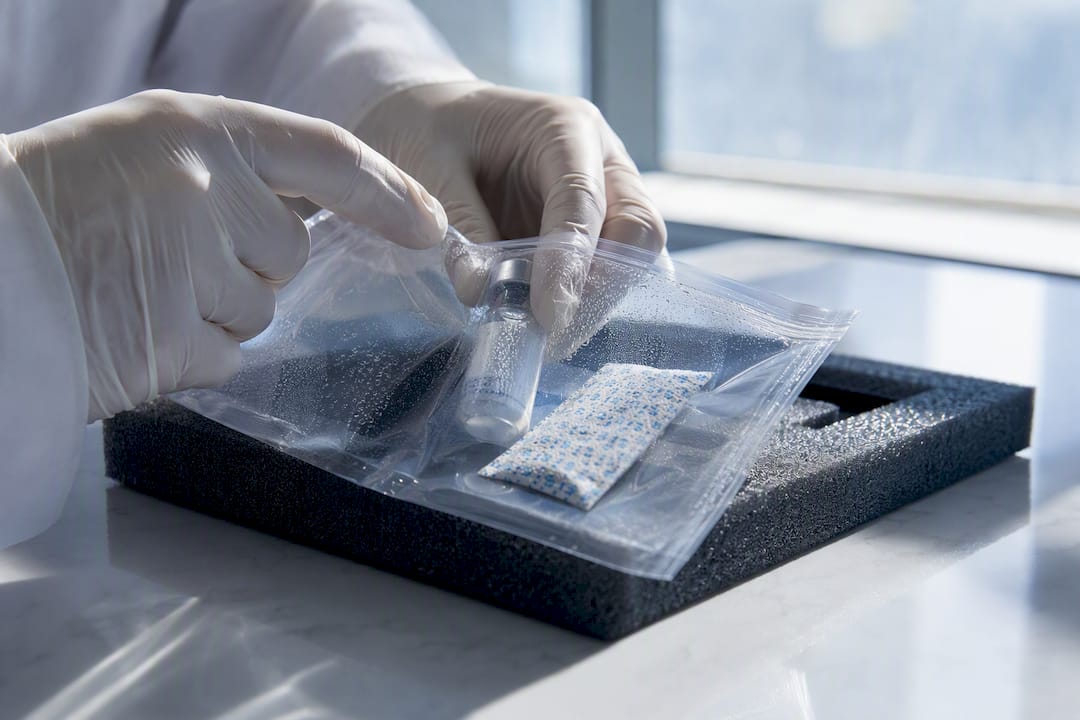
Moisture barriers matter just as much as physical cushioning. A sealed secondary bag around the vial, combined with a desiccant packet, protects against condensation that forms as a cold package moves into a warmer environment during handling or final delivery. This is especially critical for lyophilized peptide, where moisture exposure can undo the entire point of freeze-drying the compound in the first place.
Vibration during ground transport and repeated handling at sorting facilities also stresses vial seals over time, so a tamper-evident cap that’s actually seated correctly, not just present, matters more than it sounds. Buyers evaluating a new supplier can reasonably ask how their standard packaging handles a multi-leg journey involving several handoffs, since a box that survives one direct flight might not survive a shipment routed through two or three transfer points.
What Happens When a Peptide Shipment Fails Cold-Chain?
Temperature excursions happen, even with disciplined cold-chain planning. Flights get delayed, customs holds stretch longer than expected, and the summer heat on a loading dock can undo a carefully sized ice pack faster than the transit schedule anticipated. What separates a manageable problem from a wasted order is whether a contingency plan exists before the excursion happens, not after.
The core of a solid risk management approach is documentation at the moment of receipt. A temperature indicator or logger gives objective proof of whether the package stayed in range, which matters enormously if a replacement claim needs to be made. Without that evidence, a claim of thermal damage is just an assertion, and a supplier has little basis to act on it quickly. Buyers who standardize on requiring an indicator for every thermally fragile order build that evidence trail automatically, rather than scrambling to prove a problem after the fact.
The second piece is a supplier relationship where the replacement policy is clear and fast, not buried in fine print or negotiated case by case. A transparent returns process that specifically addresses documented thermal failures, separate from general damage or dissatisfaction claims, tells you the supplier has actually thought through this failure mode rather than hoping it never comes up. Institutional buyers who write cold-chain guarantees and replacement terms directly into purchasing agreements, rather than relying on a one-off request at checkout, tend to get faster resolution when something does go wrong, since the expectation was set before the problem occurred rather than argued after.
How Reliable Suppliers Handle Peptide Shipping Standards
Responsible suppliers treat packaging as part of product quality, not a separate logistics afterthought. That means providing a COA with every order, tracking lots so a problem can be traced back to a specific batch, shipping from a location close enough to limit transit time, and standing behind a clear replacement policy when something goes wrong in transit.
When you’re qualifying a new vendor, read their shipping and returns pages the same way you’d read a materials spec sheet. If those policies are vague or absent, that tells you as much about the product as any purity number on a label ever could.
— Max
Where to Verify Peptélia’s Packaging and COA Standards
Some peptide suppliers ship orders from within Europe to shorten transit time and reduce the temperature swings that longer international routes create, and each batch carries its own independently verified COA rather than a generic supplier statement.

If you’re evaluating a supplier’s actual purity documentation before you commit to an order, Peptélia’s quality and COA testing page breaks down exactly how each batch gets verified above 99% purity. For a concrete look at what arrives at your bench, check a product page like SELANK 10mg to see specs, COA availability, and packaging details before you place your first order. Procurement officers building out a purchase order can pull the language straight from Peptélia’s shipping terms and cite the COA and lot-tracking practice directly in their acceptance criteria.
Sources
- Peptide storage (NIBSC)
- Cold-chain peptide shipping explained (PeptideResearchReviews)
- Research peptide fulfillment: storage, shipping & compliance (3PLGuys)
- Peptide storage and handling guidelines (GenScript)