

A certificate of analysis (COA) only counts as evidence if it names the batch, states the test date, shows the chromatogram and names the method and testing lab, with identity confirmed by mass spectrometry where that is critical to the work – not just a purity percentage printed on a letterhead. The fastest single verification step is matching the batch number printed on the vial against the batch number on the COA, ideally through a lab lookup or a QR code that the supplier cannot alter after the fact.
TL;DR:
- Always check that the batch number on the vial matches the batch number on the COA, via a lab lookup or a QR code, to confirm authenticity.
- The COA should include a test date within the last 12 months, a chromatogram and, for identity-critical work, mass spectrometry confirmation to verify the peptide’s identity and purity.
- HPLC purity figures alone can be misleading, because salts and water content can reduce the actual peptide content to 60–85%, which undermines accurate concentration calculations.
- Endotoxin, sterility and residual solvent data are critical for cell-based experiments and should be requested if they are missing from the original COA.
- Always cross-check retention time and the MS spectrum to catch batch inconsistencies or synthesis problems before using peptides in sensitive applications.
Table of contents
- Peptide release specifications: the fields a real COA cannot skip
- How do you read HPLC purity, MS identity and NPC together?
- Why endotoxin, sterility and solvent data matter for cell work
- How do you confirm a COA is authentic, not recycled?
- A purchasing and concentration checklist for lab buyers
- What regulatory standards shape peptide release specifications?
- Beyond HPLC and MS: other ways peptides get characterised
- Setting acceptance criteria: what limits should you actually require?
- Reading chromatograms and MS traces to catch batch problems
- Why method validation matters as much as the result itself
- Do modifications like phosphorylation or amidation change the specs?
- Why COA verification belongs in every lab’s SOP
- Get COA-verified peptides without the guesswork
- Sources
Peptide release specifications: the fields a real COA cannot skip
A batch release document only earns its name when it ties a specific analytical result to a specific vial. That is the whole premise behind the peptide release guidelines used in reputable labs: identity and purity are claims, and claims need a chain of evidence.
This is what has to be on the document before it can be trusted:
- Supplier and testing lab details. The lab that ran the analysis should be named, whether it is the supplier’s own laboratory or an external one, with the lab’s contact details.
- A batch number that matches the vial. This is the anchor. Without it, the COA could belong to any batch the supplier has ever produced.
- Test date. Peptides degrade. A COA older than 12 months tells you nothing about the vial in front of you now.
- HPLC method details. Column type, gradient and detection wavelength. Different methods produce different purity values, so the method is part of the result, not a footnote.
- A chromatogram, not just a number. The chromatogram is the evidence; the percentage is the summary.
- Mass spectrometry identity confirmation, where identity is critical. Purity without identity confirmation only tells you the sample is mostly one substance, not which one.
- Net peptide content (NPC) or amino acid analysis. This converts a purity figure into the peptide mass you can actually use.
- Salt form and residual solvent information. These affect both the molecular weight calculation and safety in cell assays.
- Analyst signature or responsible contact. A named person attached to the result, rather than an anonymous template.
The red-flag combination comes up all the time: a purity figure with no chromatogram, no lab name and no batch reference. A review of supplier COA practices identified exactly this gap as the most common weak point, and it is the quickest thing to check, even before the shipping box is opened.
How do you read HPLC purity, MS identity and NPC together?
HPLC purity, or “area percent”, measures how much of the detected signal falls under the target peak relative to everything else that eluted. It says nothing about the water content, counterions or salt mass sitting in the vial alongside the peptide. Two labs running the same sample on different columns, gradients or wavelengths can report different values – which is exactly why the method details matter as much as the result itself.
Purity and identity answer different questions, and identity-critical work needs both:
- HPLC purity tells you how clean the peak is relative to detectable impurities.
- Mass spectrometry (LC-MS or MALDI) confirms that the molecule really is the sequence you ordered, not a structurally similar impurity that happens to co-elute.
- Net peptide content converts the purity figure into actual peptide mass, accounting for salts, counterions and residual moisture.
Reviews of peptide purity standards point out that a peptide at 98 to 99% HPLC area percent may contain only 60 to 85% peptide by mass once salts and water are subtracted. That gap is the difference between the solution you think you made and the one you actually made.
If you are aiming for a 1 mg/ml solution and dissolve the whole vial in 10 ml of buffer assuming HPLC purity alone, the real concentration will be closer to 0.78 mg/ml.
Why endotoxin, sterility and solvent data matter for cell work
Cell-based assays, and anything touching immune signalling, are extremely sensitive to endotoxin – and this is precisely the field most often missing entirely from supplier COAs. A peptide can show a flawless 99% HPLC chromatogram and still carry enough bacterial endotoxin to skew a cytokine assay or trigger non-specific inflammatory signals in culture.
What to require before trusting a peptide in cell-based work:
- Endotoxin testing (LAL assay) with results in EU/mg, especially for anything that touches immune or inflammatory pathways.
- Sterility confirmation for peptides used in live cell culture, not just in biochemical assays.
- Residual solvent disclosure, since trace solvents from synthesis can interfere with sensitive readouts.
If these fields are missing from a supplier’s COA, request the data directly before purchase or budget for independent sample analysis. Community testing reports have found endotoxin contamination in peptides sourced online to be common enough that its absence should not be assumed just because the purity looks clean.
Pro tip: If a supplier cannot provide endotoxin data on request, treat that silence as the answer. A peptide that is chemically pure but biologically contaminated will ruin a cell assay just as quickly as one with low purity.
How do you confirm a COA is authentic, not recycled?
The quickest fraud in this space is not fabricated data. It is real data from a different batch, reused because nobody checked the batch number. A generic COA that could belong to any shipment is worth exactly nothing.
Run these checks as soon as a shipment arrives:
- Match the batch number: the number on the vial label must match the batch number printed on the COA, character for character.
- Check the test date and be wary of anything older than 12 months, since degradation during storage and transport is real.
- Read the retention time on the chromatogram; a peak position that has shifted from the method description is a sign that something has changed.
- Look for an analyst signature or a named responsible person rather than an unsigned template.
- Check who ran the test: a named lab is the minimum; accreditation such as ISO/IEC 17025 or an online lookup tied to the batch number adds assurance.
Supplier evaluation guides consistently reach the same conclusion: transparency practices such as a batch-linked COA that can be verified through a lookup correlate with better batch-to-batch consistency under independent retesting.
A purchasing and concentration checklist for lab buyers
Good procurement habits catch problems before they turn into flawed data in a publication. Build these steps into your standard operating procedure rather than treating them as a one-off due-diligence exercise.
- Before ordering: request a batch-specific COA, not a representative or historical one, and ask for full HPLC method details and the NPC if you need accurate stock concentrations.
- On receipt: confirm the batch number matches, review the chromatogram and, where provided, the MS spectrum, and log the test date in your lab records.
- For high-stakes experiments: send a sample for independent testing rather than relying on supplier data alone, especially for anything that will feed into a publication.
The concentration maths matters more than most buyers assume. Methodological reviews of purity standards recommend calculating the target concentration from the NPC, not from the HPLC value, whenever the NPC is available on the COA.
What regulatory standards shape peptide release specifications?
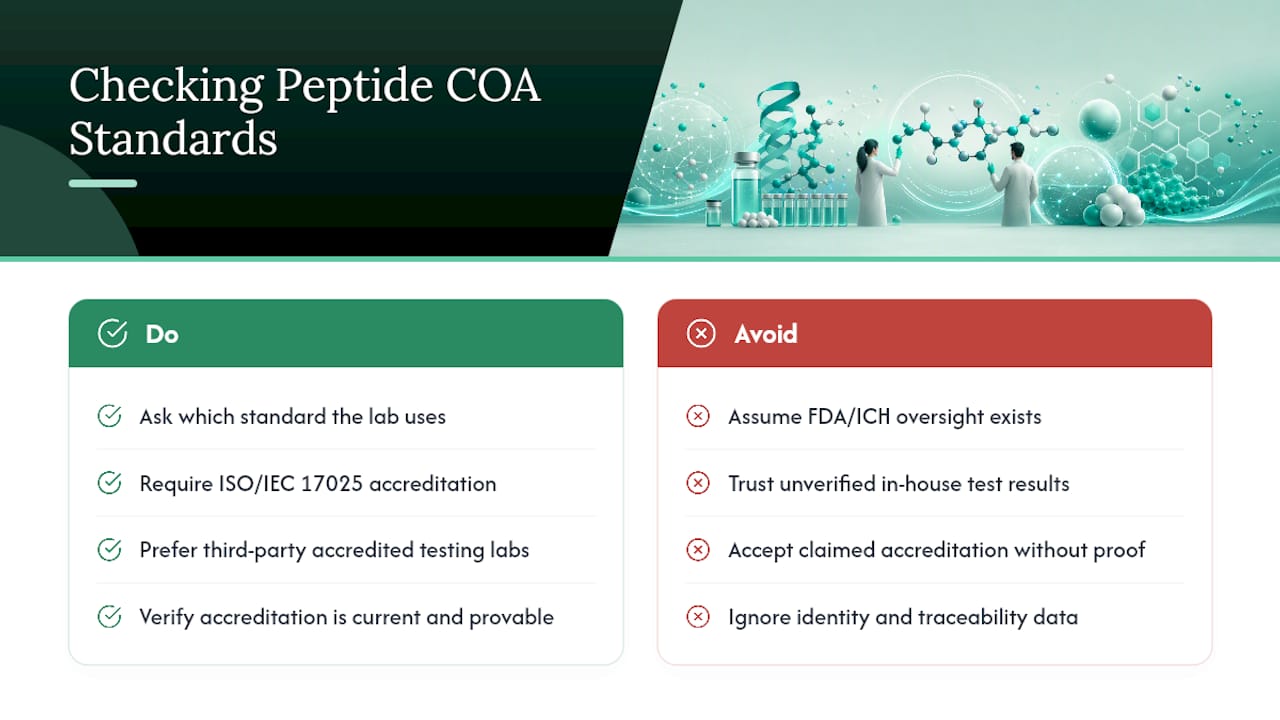
Research peptides sold for laboratory use are not medicinal products, so they do not go through FDA approval or an ICH-compliant authorisation process the way a therapeutic candidate does. That distinction matters for how you read a COA: no regulatory authority audits the lab that ran the purity test.
What does exist is a shared analytical vocabulary borrowed from pharmaceutical quality practice, even if it is applied informally. Concepts such as HPLC area percent, mass spectrometry identity confirmation and batch traceability all come from formal pharmaceutical quality control, where they are tied to strict acceptance criteria and documented validation. Research suppliers who take quality seriously adopt the same rigour voluntarily, documenting each batch verifiably and in some cases using ISO/IEC 17025-accredited third-party labs, even though no regulator requires this for research products.
That voluntary adoption is precisely what separates a credible research peptide supplier from one that cuts corners. An ISO/IEC 17025-accredited lab has demonstrated its competence in specific test methods to an independent assessment body, an assurance that in-house testing does not carry by itself; in-house results earn trust through verifiability (disclosed method, full chromatogram, matching batch number) and can be backed by an external second analysis. When evaluating a supplier, ask who ran the test, under which standard, and whether any accreditation claimed is current and verifiable, not just claimed on a website.
The absence of a regulatory requirement for research peptides does not lower the bar for what a responsible lab should demand. If anything, it increases the buyer’s responsibility to do the verification work a regulator would otherwise do.
Beyond HPLC and MS: other ways peptides get characterised
HPLC and mass spectrometry cover purity and identity, but they do not tell you everything about a peptide’s composition or concentration. Two further methods appear regularly on thorough COAs, and each answers a question the other two cannot.
Amino acid analysis breaks the peptide down into its amino acid building blocks and measures them quantitatively, which serves as an independent cross-check of both identity and content. If a peptide’s amino acid ratios do not match the expected sequence composition, that is a warning sign HPLC alone would miss entirely, because HPLC only confirms that something elutes at the expected retention time, not that its internal composition is correct.
UV spectroscopy measures absorbance at specific wavelengths (typically 280 nm for peptides containing aromatic residues such as tryptophan or tyrosine) to estimate concentration in solution. It is fast and inexpensive, but a blunt tool compared with HPLC or MS, because it cannot distinguish the target peptide from an impurity that absorbs similarly. It works best as a quick concentration check, not as proof of purity or identity.
Some labs also use circular dichroism to examine the secondary structure of larger or cyclic peptides, although this is less common for the short linear sequences that dominate research catalogues. Amino acid analysis and UV spectroscopy act as supporting evidence, useful when something in the primary data looks off and you need a second angle on the same sample.
Setting acceptance criteria: what limits should you actually require?
Acceptance criteria are the numerical thresholds a batch has to meet before it ships, and for buyers of research peptides, setting your own criteria (rather than accepting whatever a supplier calls a “pass”) is what separates a real specification from a marketing number.
There is no partial credit for identity confirmation.
For safety parameters in cell-based work, endotoxin limits should be stated explicitly in EU/mg rather than left at “endotoxin tested, pass”, because a “pass” against an unstated threshold tells you nothing about how close the batch came to that limit.
The practical step for a purchasing lab is to write these criteria down once as an internal standard and then measure every incoming COA against that standard, rather than against each supplier’s own definition of “acceptable”. That one habit protects experimental reproducibility more than any single purity value.
Reading chromatograms and MS traces to catch batch problems
A chromatogram tells a story if you know where to look, and retention time is the first line of that story. If a peptide has historically eluted at a particular point in the gradient and the main peak of a new batch shifts noticeably, that signals something has changed in synthesis, purification or even the analytical method itself – and it deserves a follow-up question before the material is used.
Shoulder peaks or unresolved double peaks right next to the main peak often point to closely related synthesis by-products, usually truncated sequences missing a residue or peptides with an incomplete deprotection step. A clean, symmetrical single peak is what you want to see; broad or tailing peaks usually mean the purification step did not fully separate the target peptide from similar impurities.
On the MS side, the diagnostic step is comparing the observed mass with the expected mass of the sequence. A mass that is off by about 18 Da often indicates water addition or water loss during synthesis; an offset equal to the mass of a single amino acid points to truncation or substitution. If the MS spectrum shows several significant peaks instead of one dominant mass, that usually means the sample is a mixture, regardless of what the HPLC purity figure claims.
The practical rule: never accept “purity looks fine” as a complete review. Check the retention time against the batch’s own history and, where MS data are provided, confirm that the MS mass matches the expected sequence mass before treating a COA as clean.
Why method validation matters as much as the result itself
An HPLC purity value is only as trustworthy as the method that produced it, and that is where validation comes in. A validated method has documented performance characteristics: specificity (can it actually separate the peptide from likely impurities), accuracy, precision (repeatability across runs) and linearity over the measured concentration range.
Labs that skip validation can still run a chromatogram and report a number, but that number carries no guarantee that it would reproduce on a different day, on a different column or with a different analyst. This is one reason the same peptide can turn up with different purity figures from different suppliers, even when both used “HPLC”. The instrument is the same; the validated method behind it may not be.
For research buyers, the practical signal is whether the COA states specific method parameters – column type, gradient, wavelength – rather than just naming the technique. Method details are not bureaucratic filler; they are what allows another lab or an independent tester to actually reproduce the measurement.
Do modifications like phosphorylation or amidation change the specs?
Peptide modifications shift both the analytical target and the acceptable range of several release parameters, and buyers working with modified peptides need to know this before comparing purity values between products.
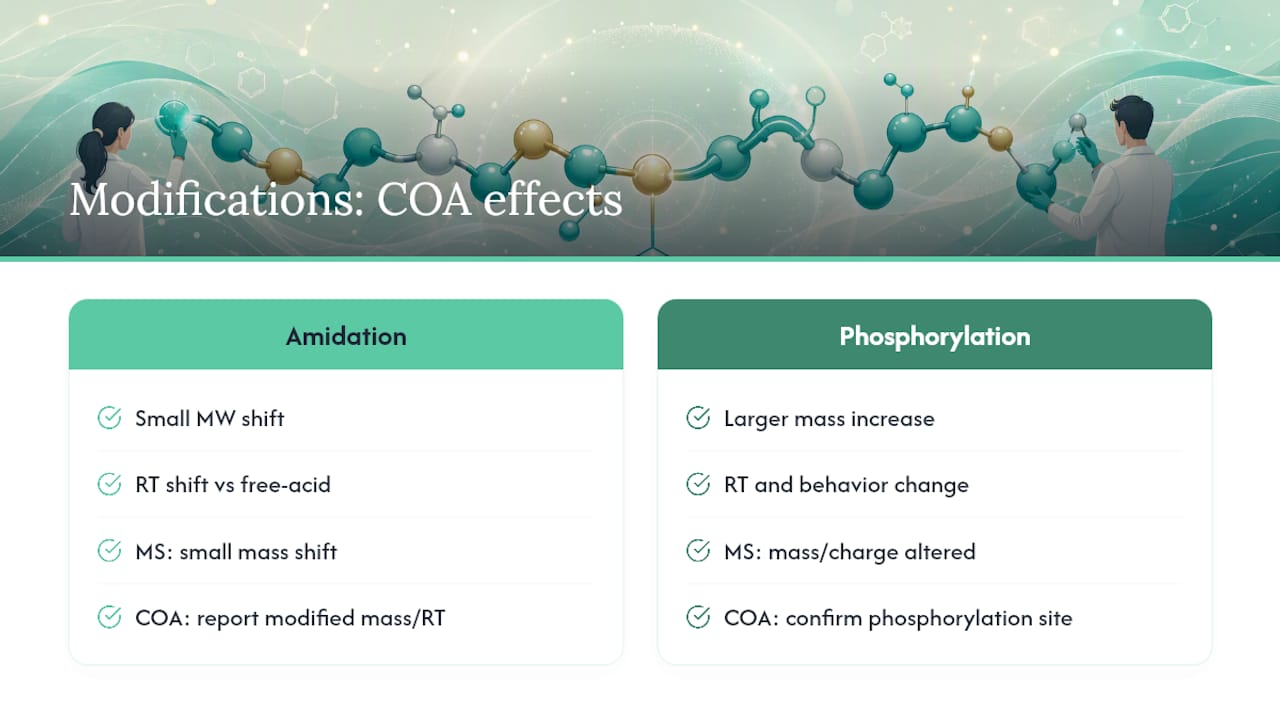
Amidation (capping the C-terminus with an amide group instead of a free acid) changes the molecular weight slightly and can shift the HPLC retention time relative to the unmodified sequence, so a chromatography method validated for the free-acid form will not necessarily perform identically on the amidated version. Mass spectrometry identity confirmation becomes even more important here, because the mass shift from amidation is small and easily mistaken for a synthesis error if the reference mass was not calculated for the modified form.
Phosphorylation adds considerable mass and changes the peptide’s charge state, which affects both HPLC behaviour and MS fragmentation patterns. The COA for a phosphorylated peptide should confirm that the phosphorylation site was verified, not just that the overall mass matches, because MS mass alone cannot always distinguish a correctly phosphorylated peptide from an isobaric variant with the modification in the wrong position.
The practical consequence: when buying a modified peptide, the expected mass and retention time stated on the COA must specifically reflect the modified form, and the identity confirmation should address the modification directly rather than treating it as a footnote to the base sequence. A supplier who cannot explain how their testing accounts for the modification is telling you that their COA template was not built for the product they are selling.
Why COA verification belongs in every lab’s SOP
The mistake I see most often is not fraud. It is habit. Researchers trust a purity figure because it looks official, not because they have checked what stands behind it. Building the batch number check and the chromatogram review into your standard operating procedure removes that guesswork entirely, and it costs perhaps five minutes per shipment.
Peptélia’s product quality and testing pages exist because this verification step should not be optional. Every batch is tested in Peptélia’s own laboratory and ships with a batch-specific COA tied to that exact batch, not to a template: HPLC and UV/Vis as standard, with mass spectrometry and endotoxin testing added depending on the product. On request, an additional second analysis by an external lab (Janoshik Analytical) is available. Making this part of your goods-receipt SOP protects reproducibility far more than any single purity threshold.
— Max
Get COA-verified peptides without the guesswork
Peptélia exists precisely for the verification problem this guide describes: every batch is tested in its own laboratory and ships with a certificate of analysis tied to its specific batch number, with HPLC and UV/Vis data as standard and mass spectrometry added depending on the product, so nobody has to match a generic template against their own vial.

That transparency extends across the entire catalogue, from neurocognitive research peptides such as Selank to metabolic and regenerative options for preclinical and cellular work. Orders ship quickly and securely from the EU, and the full quality and lab testing practices are documented for procurement teams that need to satisfy internal SOPs before purchasing. If a lab wants an additional second analysis by an external lab (Janoshik Analytical), or has questions about batch documentation, the Peptélia team can be contacted directly.
Sources
- Peptide Purity: What Your COA Numbers Mean | Peptide Grades
- How to Read a Peptide COA: 8 Checks Before You Trust It
- Peptide purity standards: HPLC, mass spec, and what >98% really means | Compound Review
- How to Read a Peptide Certificate of Analysis (CoA)





