

Lyophilised peptides stored dry, cold and dark can remain stable for years, whereas reconstituted peptides in solution typically last only days to a few weeks in the refrigerator. The common advice to use reconstituted peptides within about a month is based mainly on the sterility limits of bacteriostatic water, not on a scheduled chemical breakdown of the peptide. The most important operational rule: keep peptides dry and frozen until use, and aliquot reconstituted material immediately to avoid repeated freeze–thaw cycles and vial punctures.
TL;DR:
- Peptides must be stored dry and frozen to maximise stability; reconstituted solutions typically keep for no more than a month in the refrigerator.
- Repeated freeze–thaw cycles and vial punctures accelerate peptide degradation, so aliquoting into single-use vials immediately after reconstitution is essential.
- Peptide stability depends on sequence, particularly for peptides containing cysteine, methionine or tryptophan, which are more prone to oxidation and should be stored with care.
- Storage in sealed, inert-gas-flushed vials at −20 °C extends the shelf life of lyophilised powders to several years, but solutions require stricter conditions.
- Temperature excursions during shipping or storage call for prompt inspection and verification, as they can irreversibly damage peptide integrity.
Table of contents
- What changes the moment you reconstitute a peptide
- Realistic shelf-life windows by storage condition
- Which amino acid residues drive degradation
- Storage and handling steps that actually protect your inventory
- Why the 28-day rule exists and how to apply it
- Handling peptide shipments without losing potency
- Spotting degraded peptide before it wrecks your data
- Batch-level testing gives you a real basis for storage planning
- What most labs get wrong about peptide shelf life
- Order peptides with documentation that matches your storage records
- Sources
What changes the moment you reconstitute a peptide
Lyophilised peptide powder is chemically inert in a way a solution never is. Removing residual moisture stops hydrolysis and slows oxidative reactions, which is why a freeze-dried vial can sit in the freezer for years while the same peptide in solution starts to degrade within weeks. Water is the catalyst for both hydrolysis and many oxidation pathways, and lyophilisation deprives these reactions of the medium they need to proceed.
The moment solvent is added, two risks appear at once: chemical degradation and microbial contamination. Bacteriostatic water offers some protection against bacterial growth, but it does not prevent hydrolysis of the peptide bond or oxidation of a methionine residue.
That is why the first step after reconstitution should be aliquoting, not storage as a single bulk vial. Practical steps:
- Aliquot into single-use cryovials immediately after mixing, sized for one experiment or working session.
- Label each vial with the reconstitution date and the solvent used.
- Avoid freeze–thaw cycles entirely for critical assay material; every thaw cycle degrades a measurable fraction of the active peptide.
- Reserve re-lyophilisation for peptides that need long-term storage but cannot be used up within the usage window.
Realistic shelf-life windows by storage condition
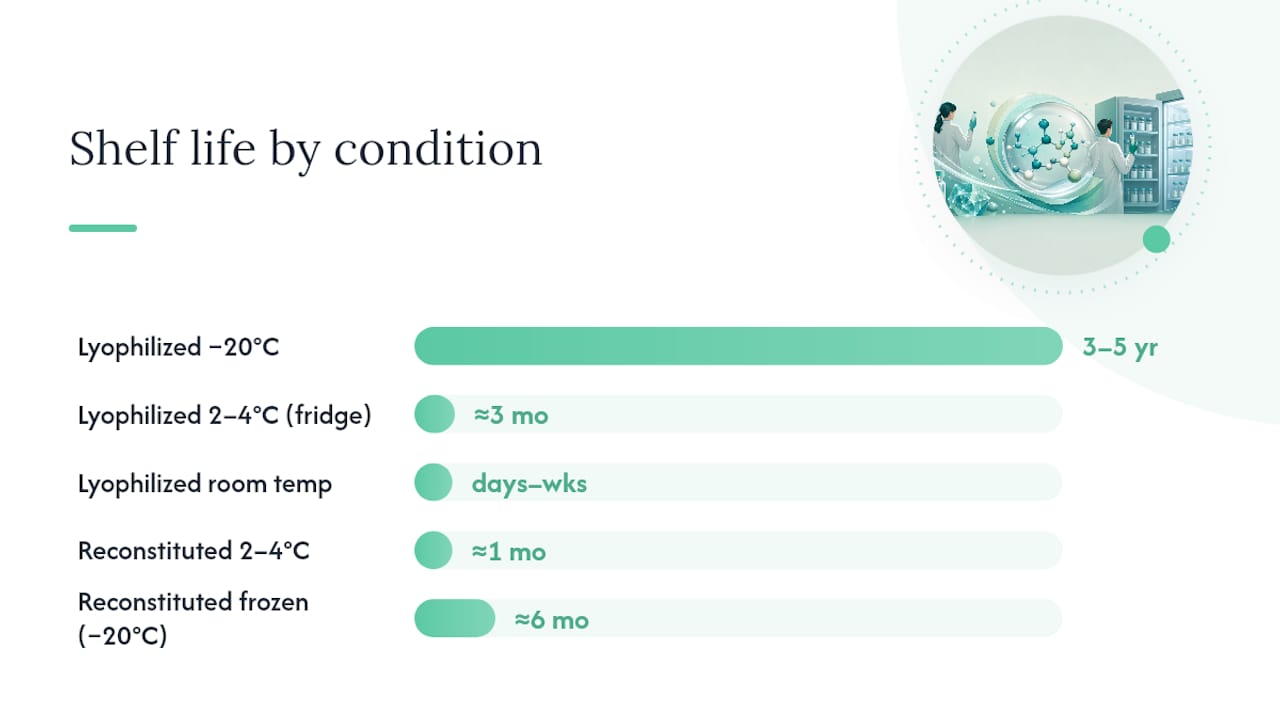
Shelf life depends almost entirely on two variables: form (powder or solution) and temperature. The peptide storage recommendations from NIBSC name dry, cold and dark conditions as the baseline, with lyophilised peptides remaining stable long-term at −20 °C.
| Form | Storage condition | Typical shelf life |
|---|---|---|
| Lyophilised (powder) | −80 °C | Several years, minimal degradation |
| Lyophilised (powder) | −20 °C | 3 to 5 years for many peptides |
| Lyophilised (powder) | 2 °C to 4 °C (refrigerator) | several months for some peptides |
| Lyophilised (powder) | Room temperature | short-term, days to weeks |
| Reconstituted (solution) | 2 °C to 4 °C (refrigerator) | up to about one month, depending on peptide and solvent |
| Reconstituted (solution) | −20 °C or −80 °C (frozen aliquots) | several months if freeze–thaw cycles are minimised |
Pro tip: A peptide that sat at room temperature over a weekend during a long protocol is not ruined, but it should be treated from then on as a batch with a shortened usage window. Log the excursion in your inventory notes rather than assuming nothing happened.
Some sequences do not follow the general table. Copper peptides and other oxidation-prone sequences usually need shorter usage windows and closer monitoring, a pattern confirmed by the recent literature on peptide stability and handling. Any peptide with cysteine, methionine or tryptophan residues should be classed as higher risk, regardless of what the general table says.
Which amino acid residues drive degradation
Peptide stability is sequence-dependent, and knowing which residues are present tells you which degradation pathway deserves the most attention. Sigma-Aldrich’s technical guide to peptide stability describes the main failure mechanisms clearly:
- Hydrolysis, particularly at aspartate residues, cleaves the peptide backbone and is accelerated by moisture and certain sequence motifs such as Asp-Pro.
- Deamidation at asparagine and glutamine converts these residues into aspartate or isoaspartate, altering charge and structure.
- Oxidation affects cysteine, methionine and tryptophan, the three residues most vulnerable to reactive oxygen.
- Diketopiperazine and pyroglutamate formation occur at N-terminal glutamine or glutamate residues, especially in short peptides.
- Racemisation can occur under certain pH and temperature stress, converting L-amino acids into D-forms that alter biological activity.
Pro tip: If the peptide sequence contains Cys, Met or Trp, consider storage under inert gas or in a desiccator vial rather than a standard freezer box. The extra five minutes of preparation cost less than losing a batch mid-study.
The countermeasures come down mainly to controlling the environment: keep the pH within the range in which the sequence is stable, exclude oxygen where possible and use desiccant for any lyophilised peptide that is not vacuum-sealed.
Storage and handling steps that actually protect your inventory
Good peptide storage practice boils down to a short list of habits applied consistently:
- Choose the right container. Glass or peptide-compatible plastic vials with a tight seal minimise headspace and oxygen exposure; for oxidation-sensitive peptides, flush the headspace with inert gas before sealing.
- Aliquot before you need to. Work out your typical usage volume in advance and split the reconstituted solution into the matching number of single-use vials on the day you prepare it.
- Label everything with a puncture date. Treat a vial without a reconstitution date as expired.
- No frost-free freezers for long-term stock. Frost-free units cycle their temperature to prevent ice build-up, which means repeated freeze–thaw stress for everything stored inside; this warning also appears in supplier handling guidance.
- Store vials at the back of the refrigerator, never in the door. Door compartments see the biggest temperature swings every time the unit is opened.
- Record everything in the LIMS or lab notebook. Storage condition, reconstitution date and number of thaw cycles should be searchable, not recalled from memory.
Pro tip: If a peptide is central to a study running for several months, a small stability pilot up front is worth it: aliquot several vials, thaw one per week and record any assay drift. That data gives you the actual maximum number of thaws instead of a generic estimate.
Why the 28-day rule exists and how to apply it
The choice of solvent sets the upper limit on how long a reconstituted peptide remains usable. Bacteriostatic water is the standard for most research peptides; sterile water without preservative should be used the same day. Sterile saline or a mildly pH-buffered solution suits peptides that are sensitive to the benzyl alcohol preservative in bacteriostatic water. Most peptides are most stable in solution at around pH 5 to 6, a range supported by review data from Pharmaceutics on aqueous peptide formulation and stabilisation strategies.
The guideline of about one month goes back to labelling conventions for multi-dose vials of bacteriostatic water, not to a limit set by peptide chemistry. Within that window, sterility rather than molecular breakdown is usually the limiting factor.
- Record the puncture date the first time you draw from a multi-dose vial.
- Discard any reconstituted solution after about one month, regardless of how it looks.
- Where possible, prefer single-dose aliquots over one large multi-dose vial; fewer punctures mean less contamination risk.
Handling peptide shipments without losing potency
Cold-chain breaks during transport are among the most frequently overlooked causes of early peptide degradation. On arrival, check any temperature indicator and refrigerate or freeze the shipment straight away, even before you have finished unpacking.
- Check the packaging for melted gel packs or condensation, both signs of a temperature excursion.
- Lyophilised peptides generally tolerate brief transport at room temperature; reconstituted or liquid formulations need actively cooled shipping.
- Quarantine anything that looks compromised and flag it for QC before it enters general inventory.
- Log every excursion with date, duration and estimated temperature, then decide whether the batch needs verification testing before use.
Spotting degraded peptide before it wrecks your data
A visual check quickly reveals obvious problems. Cloudiness in a solution that was originally clear usually points to aggregation or microbial growth. A precipitate indicates loss of solubility, often due to pH drift or a concentration error. A colour change, particularly yellowing, can indicate ongoing oxidation.
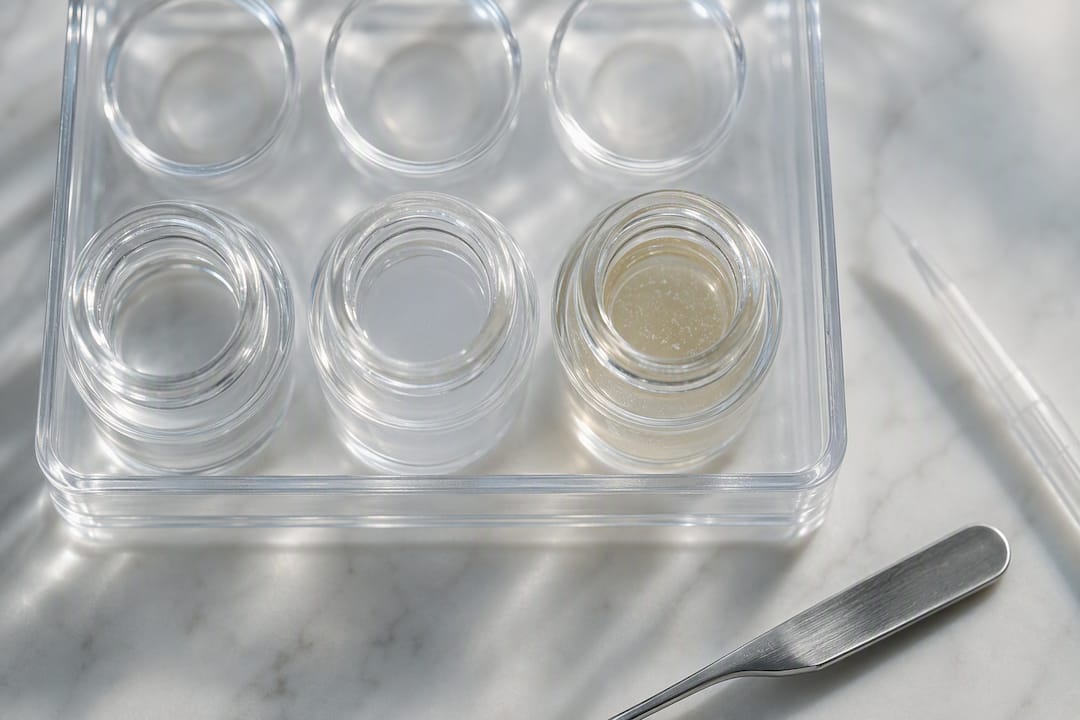
Visual checks are no substitute for analytical confirmation. For every critical batch, run HPLC or LC-MS analysis on receipt, after any suspected temperature excursion and at regular intervals for peptides in long-term storage. If a peptide shows both cloudiness and discolouration, discard it rather than risk an experimental run. If a result is ambiguous, a quick pilot assay against a fresh reference batch usually settles the question faster than repeated retesting.
Batch-level testing gives you a real basis for storage planning
Fast EU shipping supports cold-chain integrity from dispatch to delivery. When requesting a certificate of analysis (COA), ask specifically for residual moisture data and storage recommendations. Residual moisture is the one figure that shows how close a lyophilised batch is to the ideal dry state that gives it years rather than months of stability.
What most labs get wrong about peptide shelf life
Most degradation problems come down to a handful of avoidable habits: leaving a reconstituted vial in the refrigerator door, skipping the puncture date or assuming a peptide is fine because it still looks clear. Dry, cold, dark storage combined with disciplined aliquoting solves most of them. Request a COA before buying and log every change in storage condition in your lab records.
— Max
Order peptides with documentation that matches your storage records
Every batch is tested in Peptélia’s own laboratory and receives a batch-specific COA, which gives your storage records a documented starting point for the batch.

Fast shipping from the EU, with dispatch on the next business day, means less time in transit, where temperature control matters most, and every order arrives with the batch-linked details your SOPs need for inventory tracking. Whether you are stocking Selank for neurocognitive research or building a broader research plan, the quality and testing page sets out what each COA covers.
Sources
- Peptide storage guidance — NIBSC
- Designing formulation strategies for enhanced stability of therapeutic peptides in aqueous solutions — Pharmaceutics 2023
- Peptide stability and potential degradation pathways — Sigma-Aldrich technical article
- Recent peptide stability/handling summary — Springer article





