
The actual peptide fraction, the net peptide content, is often lower once trifluoroacetate salts, residual water and buffer components are taken into account. Before trusting the number, ask for two things: the full HPLC chromatogram with its method and, where identity is critical, a mass spectrometry identity report.
TL;DR:
- High HPLC purity does not guarantee the actual peptide mass; residual salts, moisture and TFA salts can account for up to 40 % of the total weight.
- Peptide identity should be confirmed with mass spectrometry data and full chromatograms, because a single purity percentage is not sufficient verification, especially when comparing suppliers.
- The small impurity fraction typically includes truncated sequences, oxidised or deamidated variants, residual salts, solvents and endotoxin, each of which can affect different assays in different ways.
- For accurate stock solutions, use the net peptide content percentage rather than the HPLC purity figure, accounting for all non-peptide components that inflate the label weight.
- Suppliers who provide complete, verifiable COAs with chromatogram and MS data protect the accuracy and reliability of your data, unlike those who offer only unsupported purity claims.
Table of Contents
- What “99 % Peptide Purity” Actually Measures: Area Percent vs. Absolute Content
- How Labs Measure It: Reversed-Phase HPLC and MS Confirmation
- The Impurities Hiding in That Last 1 %
- When You Actually Need 99 % Purity, and When You Don’t
- Converting Purity Numbers into Actual Weigh-Ins and Concentrations: NPC Calculations
- What a Real COA Should Show, and the Questions to Send a Supplier
- How Peptélia Verifies Every Batch
- Ordering COA-Verified Peptides for Your Next Study
- A Lab Supplier’s Take on Purity Claims
- Sources
What “99 % Peptide Purity” Actually Measures: Area Percent vs. Absolute Content
Most suppliers report chromatographic purity, calculated as the integrated area of the main peak divided by the total integrated area under the UV trace. It is a proportional measurement of the sample relative to everything else that eluted during a reversed-phase HPLC run. It tells you almost nothing about what fraction of the dry mass in the vial is actually peptide.
That second quantity has a name: net peptide content (NPC), sometimes called absolute peptide content. It is determined by amino acid analysis (AAA) or nitrogen analysis rather than by chromatography, and it accounts for everything the HPLC trace does not separate, mainly counterions, moisture and inorganic salts. For TFA salt peptides, residual trifluoroacetate can make up 10 to 40 % of the total mass in sequences with several basic residues such as arginine or lysine.
TFA is not washed out during freeze-drying. It is ionically bound to basic side chains and stays there throughout lyophilisation. Removing it requires a dedicated counterion exchange, switching to the acetate or hydrochloride salt through a separate desalting or ion-exchange step, which is why salt-converted peptides are often more expensive.
What this means for lab work:
- A high HPLC value confirms that the sample is chemically clean relative to synthesis by-products.
- It does not confirm how much peptide mass actually ends up in a tube when you weigh it out.
- For any assay where concentration matters, you need the NPC value, not just the area percent value, to calculate a correct stock solution.
How Labs Measure It: Reversed-Phase HPLC and MS Confirmation
The purity figure on a certificate of analysis comes from a defined analytical sequence, and every step has parameters that shift the final result.
- Reversed-phase HPLC separation. The peptide sample runs through a C18 column (occasionally C8) under a water/acetonitrile gradient, typically with 0.1 % TFA as the ion-pairing reagent. Detection is at 214 nm, the wavelength that captures peptide bond absorbance, sometimes supplemented by a 280 nm channel when the sequence contains aromatic residues such as tryptophan or tyrosine.
- Area percent integration. The software integrates every peak above a set threshold and calculates the main peak’s share of the total area. Baseline construction, integration threshold and total run time all change the result. A method that ends the run before late-eluting impurities appear will report a higher purity than a longer, more complete run would show.
- Mass spectrometric identity confirmation. MS, usually electrospray ionisation time-of-flight or MALDI, confirms that the molecular weight of the main peak matches the expected sequence. It is an identity check, not a quantitative purity check, and it has blind spots of its own: isotope clusters, sodium or potassium adducts and instrument resolution can complicate interpretation for larger peptides.
A COA that lists only a number without method details does not give you enough to evaluate the claim. Look for column type, solvent system, gradient profile, total run time, detection wavelength and integration parameters. Thermo Fisher’s custom synthesis documentation treats HPLC plus MS as the basic QC combination for research-grade peptide products, and this combination has become the working standard across the industry.
A point worth repeating to your lab manager: two suppliers can measure the same peptide by HPLC and report different area percent values purely because of their integration settings. A percentage without the method behind it is almost meaningless for comparison purposes.

The Impurities Hiding in That Last 1 %
That 1 % (or more, once NPC comes into play) is not a single contaminant. It is usually a mixture of several impurity classes, and which ones dominate determines how much risk they pose to a particular experiment.
- Truncated or deletion sequences. Incomplete coupling during solid-phase synthesis leaves shorter fragments missing one or more residues. These often have retention properties close to the full-length peptide, which makes complete resolution difficult.
- Oxidised, deamidated or racemised variants. Methionine and cysteine residues oxidise easily; asparagine and glutamine deamidate over time or under heat. Racemisation during synthesis inverts the stereochemistry of a residue, which can quietly abolish receptor binding without changing the molecular weight reported by MS.
- Residual salts and counterions. TFA and acetate are the most common; they sit outside the peptide backbone but contribute to the total mass of the sample.
- Residual solvents and endotoxin. Traces of acetonitrile, DMF and DMSO from synthesis and purification, as well as bacterial endotoxin picked up during processing or handling, are impurities that HPLC purity testing does not detect at all. Peptides have been documented passing HPLC purity tests while still exceeding endotoxin limits, which is why endotoxin testing is a category of its own alongside purity testing.
For binding assays and enzymology, truncated variants are usually the bigger concern, because they can act as weak competitive inhibitors and distort the concentration-response curve. In cell-based work, endotoxin contamination is the critical issue, since even trace amounts can trigger inflammatory signalling that has nothing to do with the peptide under study.
Pro tip: If your assay involves immune cells, macrophages or an inflammation-sensitive readout, request a separate endotoxin certificate. HPLC purity and endotoxin load are measured by entirely different methods, and a clean chromatogram tells you nothing about lipopolysaccharide contamination.
When You Actually Need 99 % Purity, and When You Don’t
Purity requirements should be guided by how sensitive the assay is to interference, not by a blanket preference for the highest number available. Aiming for 99.5 % in a screening assay where 95 % would perform identically is money spent on a variable that does not change the result.
- ≥99 % purity: mechanistic studies, potency curves intended for publication and any concentration-response work in which a small shift in EC50 or IC50 would be scientifically significant.
- ≥98 % purity: most receptor binding assays and standard cell-based work, where trace truncated variants are unlikely to shift the result measurably.
- 95 to 98 % purity: early screening, feasibility work and internal exploratory studies used to decide whether a peptide merits further investment.
Beyond a certain point, higher purity yields diminishing returns relative to its cost. The extra money is better spent on the test that actually reduces uncertainty in your specific assay, not on a marginal purity increase that will not be detectable in your results anyway.
Converting Purity Numbers into Actual Weigh-Ins and Concentrations: NPC Calculations
This is where many concentration errors quietly creep into published data.
For TFA salt peptides, net peptide content typically lies between 60 and 90 %, depending on how many basic residues the sequence carries. Here is how that works out in practice:
- Start with a vial labelled 1 mg, 98 % HPLC purity.
- Check the COA for net peptide content. If the NPC is stated as 75 %, the vial contains roughly 0.74 mg of actual peptide, not 0.98 mg.
- The remaining 0.20 mg to 0.24 mg or so is TFA salt and moisture, with no peptide mass at all.
- For a stock solution at a target concentration, use 0.74 mg in the calculation, not the label weight and not the HPLC percentage.
- Recalculate the dilution series on the basis of this corrected mass before running the assay.
If steps 2 and 3 are skipped, every concentration in the concentration-response curve carries the same systematic error. This is not random noise that averages out across replicates. It is a consistent offset that shifts the entire curve, and exactly the kind of error that later surfaces as an unexplained discrepancy when someone tries to replicate the published EC50.
Common weighing and dilution errors to double-check before you start:
- Using the label weight instead of the NPC-corrected weight for stock solution calculations.
- Assuming that HPLC area percent and net peptide content are the same number.
- Skipping a fresh NPC check after changing suppliers, since NPC varies with sequence and synthesis batch.
- Not correcting for water content when the peptide is hygroscopic and has been exposed to air.
What a Real COA Should Show, and the Questions to Send a Supplier
A certificate of analysis is only useful if it gives you enough to verify the claim yourself, rather than a number you have to take on trust.
At a minimum, a trustworthy COA contains a complete chromatogram image (not a cropped or truncated trace), the HPLC method parameters and the named testing lab; add a mass spectrum confirming molecular identity for identity-critical work, the method used to determine peptide content where the stock concentration depends on it, and an endotoxin result if the peptide is intended for cell-based work.
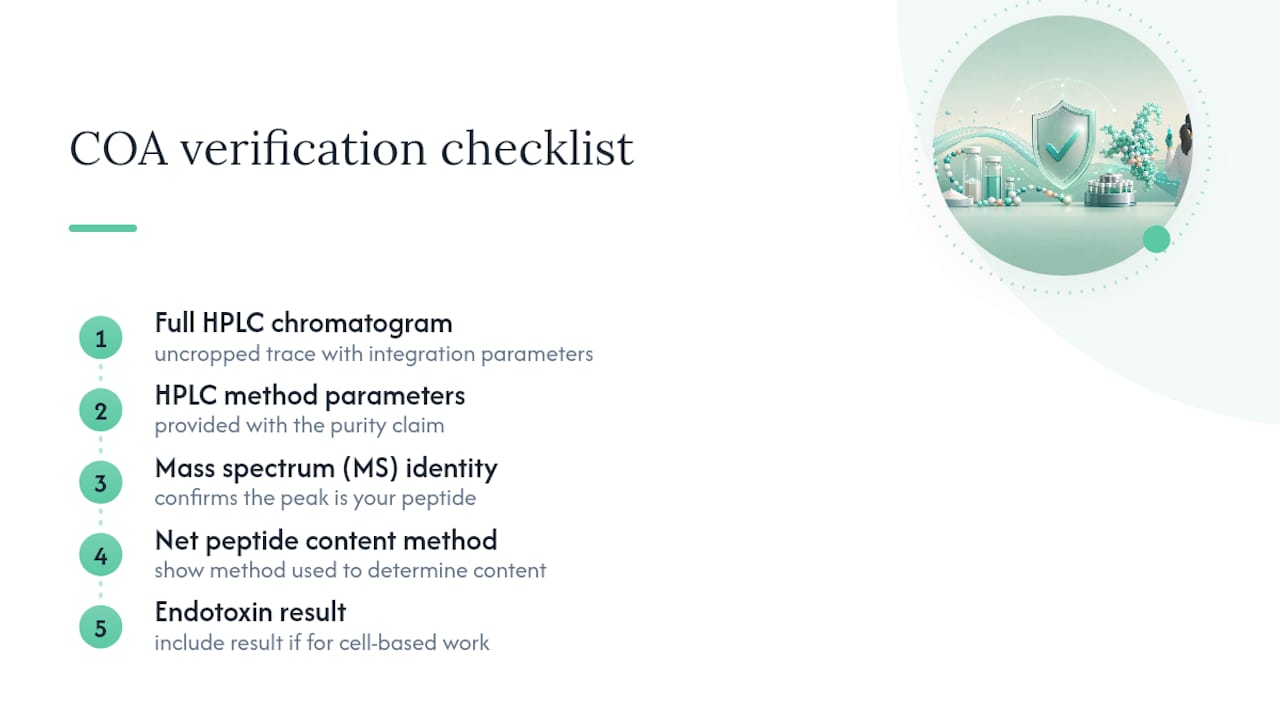
Red flags: a COA without a chromatogram image, a purity claim without accompanying method parameters, or an area percent value without MS data confirming that the peak really is the peptide you ordered. Independent laboratory testing has found that 43 % of peptides submitted for third-party testing did not meet their stated purity claims, with some lower-tier suppliers advertising 99 %+ while independent testing measured actual purity in the range of 71 to 91 %. That gap is exactly why a verifiable document matters more than a number you are asked to trust.
Pro tip: Before ordering, send every supplier exactly this request: “Please provide the full HPLC chromatogram with integration parameters, the MS spectrum confirming identity, the method used to determine net peptide content and, if available, endotoxin data.” A supplier with a serious testing infrastructure will already have these documents on file.
How Peptélia Verifies Every Batch
Testing every batch by HPLC and issuing a certificate of analysis with the full chromatogram for every product sold, rather than a single summary percentage, is recommended best practice. At Peptélia, every batch is tested in our own lab by HPLC and UV/Vis spectroscopy and receives a batch-specific COA; on request, an additional second analysis by an external lab (Janoshik Analytical) is available. This matches the verification standard set out above: a document that researchers can actually check, not just a claim they have to accept.
Products such as GHK-Cu, Semax and TB-500 each come with their own COA-verified test documentation, available via Peptélia’s product quality testing page. For researchers choosing between suppliers, that is the difference between reading a number and reading the data behind it.
Ordering COA-Verified Peptides for Your Next Study
If you have read this far, you already know the gap between a purity claim and a verifiable one. Peptélia addresses that gap by testing every batch in its own laboratory and issuing a batch-specific COA, so nobody has to rely on a supplier’s word about what is in the vial.

Every product page lists its own test documentation, and the product quality testing page explains the analytical methods behind each certificate. For neurocognitive research, Semax and Selank are both available with full COA documentation, and regenerative research applications are covered by products such as TB-500 and GHK-Cu. Orders ship from the EU with dispatch on the next business day, free shipping from €100 and bacteriostatic water included with every order, backed by lab-focused support for batch-specific questions before you commit budget to a study.
Start by checking the COA for the peptide you need, then place your order through the Peptélia shop with the documentation already in hand.
A Lab Supplier’s Take on Purity Claims
Treat a bare purity percentage the way you would treat an unsupported claim in a manuscript: interesting, but nothing to build a result on until you have checked the source. Check the chromatogram and the MS data first, then the number attached to them. When calculating an actual weigh-in or stock concentration, always use the net peptide content, not the HPLC value, because that is the number that decides whether your dilution series is correct or systematically shifted. If your assay is endotoxin-sensitive, request that data as a separate item, since no purity method covers it. None of this is complicated once you know what to ask for. It just requires asking before the order ships, not after the data fail to replicate.
— Max
Sources
- Peptide Purity: What Your COA Numbers Mean | Peptide Grades
- Custom Peptide Synthesis Services | Thermo Fisher Scientific – US





