
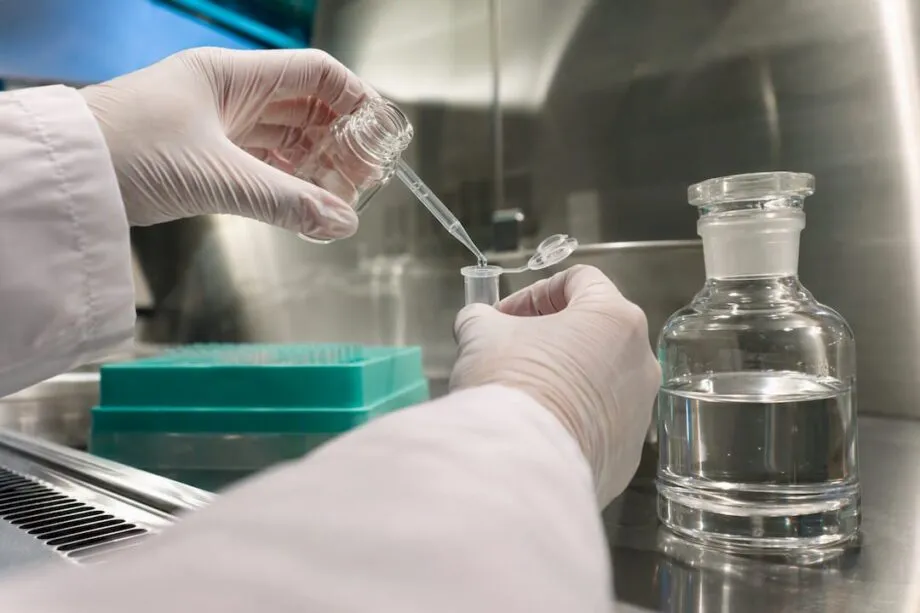
Peptide counterion exchange replaces the salt bound to a synthetic peptide, usually trifluoroacetate left over from HPLC purification, with a target anion such as chloride or acetate. It matters because that residual counterion can skew assay results, interfere with mass spectrometry and even alter peptide conformation. The best-supported approach for most peptides is lyophilization from 10 mM HCl or a combined RP-SPE purification/exchange step, followed by confirmation with 19F-NMR or HPLC-ELSD.
TL;DR:
- Residual trifluoroacetate from HPLC purification can change peptide conformation, activity and mass-spectrometry sensitivity, which makes exchange necessary.
- Counterion exchange methods include lyophilization with 10 mM HCl, RP-SPE purification and organic resin treatment, each suited to different peptide types and lab setups.
- Confirming a successful exchange requires 19F-NMR, HPLC-ELSD or FT-IR to measure residual TFA, with targets below 0.36 percent for reliable results.
- Sequence composition affects exchange efficiency, especially for peptides rich in basic residues or with hydrophobic character, which calls for adapted protocols.
- Peptides with a pre-specified salt form from suppliers with verified COAs save time and ensure consistency, reducing the need for in-house exchange.
Table of contents
- Why counterion identity changes how a peptide behaves
- Common counterions and how to pick one
- Comparing the three main exchange methods
- Confirming the exchange actually worked
- A practical protocol checklist you can adapt
- When the exchange doesn’t go as planned
- What to demand on a certificate of analysis before you buy
- Where this field is heading
- Where to get peptides with the counterion already handled
- Sources
- FAQ
Why counterion identity changes how a peptide behaves
The counterion is not passive packaging. It sits next to the positively charged side chains of lysine, arginine and histidine, and that electrostatic pairing shapes how the peptide folds, aggregates and crosses membranes. Swap the anion and the biology you are trying to measure can shift without anyone noticing.
Trifluoroacetate is the biggest offender because it is the near-universal by-product of reversed-phase HPLC purification with TFA-based mobile phases. It is also unusually good at ion-pairing with basic residues, stabilising certain helical conformations in ways that acetate or chloride simply do not reproduce. The antimicrobial peptide LL-37 and various cell-penetrating peptides (CPPs) are the textbook cases: work on counterion effects on peptide structure shows that peptides can adopt more ordered, alpha-helical states in the presence of specific counterions such as sulfate or TFA, and that this shift changes the measured antimicrobial activity. Run a bioassay with a TFA-salt peptide, compare it with a chloride-salt version from another vendor, and you may be comparing two functionally different molecules without realising it.
The downstream consequences show up in three places:
- Membrane permeation studies. CPP uptake experiments have shown markedly different permeation behaviour depending on whether the peptide carries TFA or a physiological counterion, which matters enormously for drug-delivery modelling.
- Mass spectrometry. TFA suppresses ionisation efficiency in positive electrospray mode, so a peptide loaded with residual TFA can give a weaker, noisier MS signal than the identical sequence as an acetate.
- Formulation and toxicity considerations. TFA has raised toxicity concerns in some in vivo contexts, which is part of why regulatory-oriented work increasingly sets acceptable residual limits rather than ignoring the counterion altogether.
Reproducibility fact: Inconsistent counterion reporting between labs is a recurring, underrated cause of batch-to-batch variability in published peptide results. Two groups studying “the same peptide” can get different folding or activity data simply because one used a TFA salt and the other exchanged to acetate, and neither paper mentions it.
That is the practical argument for treating peptide counterion exchange as a required workflow step, not an optional clean-up. If your assay is sensitive to secondary structure, aggregation state or ionisation efficiency, the counterion is an experimental variable that has to be controlled and documented, just like solvent or pH.

Common counterions and how to pick one
Three counterions dominate research peptide work, and the choice usually comes down to what happens to the peptide once it leaves the bench.
Trifluoroacetate (TFA) is what you get by default from RP-HPLC purification. It gives excellent peak shape and resolution during purification because it is a strong ion-pairing agent, but that same property becomes a liability downstream. Reviews of ion-pairing effects in peptide separation note that hydrophobic counterions such as TFA improve chromatographic peak shape but can measurably reduce MS sensitivity, which is exactly the trade-off you want to avoid before a proteomics run or a quantitative bioassay.
Chloride (Cl⁻) is the closest thing to a physiological counterion for most cell-based and in vivo work, and it is the default target most labs exchange into. It is also the anion at the centre of the field’s emerging consensus protocol, discussed below.
Acetate (Ac⁻) is a common middle-ground option, particularly favoured when a peptide is headed for formulation work where chloride salts complicate solubility, or when a slightly less aggressive acid environment is wanted during the exchange.
Selection criteria to work through before any exchange:
- Type of downstream assay. Cell culture and animal work generally favour chloride; some formulation and stability studies favour acetate.
- MS sensitivity requirements. For LC-MS/MS quantification, TFA should be removed regardless of which anion replaces it.
- Solubility profile. Highly hydrophobic peptides sometimes behave better with acetate than with chloride, but this has to be tested empirically for each sequence.
- Presence of non-standard residues. Peptides with unusual side chains, D-amino acids or extensive modifications can bind counterions less predictably, so confirm completeness of exchange analytically rather than assuming a standard protocol behaves the same way.
- Toxicity and regulatory context. If the peptide is destined for any in vivo use, residual TFA limits become a real specification, not a nice-to-have.
Sequence composition also matters more than you might expect. A peptide rich in arginine and lysine has more ion-pairing sites and can be harder to exchange completely than one with fewer basic residues, which is one reason a single fixed protocol does not perform identically across every sequence in a library.
Comparing the three main exchange methods
Three workflows cover the vast majority of counterion exchange in peptide labs: HCl lyophilization, simultaneous RP-SPE purification and exchange, and anion-exchange resin (AER) treatment in organic solvent. Each fits a different combination of peptide type, equipment access and time pressure.
HCl lyophilization (aqueous exchange). The peptide is dissolved in dilute hydrochloric acid and then freeze-dried, repeating the cycle as needed until the target anion has displaced TFA. A systematic study across several peptide sequences identified 10 mM HCl as the optimal concentration, bringing residual TFA below the limit of detection without compromising peptide purity, with the analytics validated according to ICH guidelines. This is the workflow most labs default to, because it needs nothing more than a freeze-dryer and dilute acid.
Simultaneous RP-SPE purification and exchange. Solid-phase extraction cartridges allow purification and counterion exchange in a single pass by washing the bound peptide with an acid solution containing the target anion before elution. Optimised protocols in this category have delivered peptides at 82 to 97 percent chromatographic purity with residual TFA below the reported limits, collapsing two separate unit operations into one. It is considerably faster and generates less solvent waste than repeated lyophilization cycles, which is why it is emerging as the greener default for routine peptide work.
Anion-exchange resin (AER) in organic media. For hydrophobic peptides or ion pairs that do not behave well in water, an AER preloaded with the desired anion exchanges it directly for the existing halide or TFA in an organic solvent system. Studies of AER-based halide-for-anion exchange in organic media report exchange yields above 90 percent for many ion pairs when solvent polarity is set correctly, often with acetonitrile or acetonitrile/dichloromethane mixtures. Recovery is highly sensitive to solvent choice, so this method needs more up-front optimisation than the aqueous options.
Here is how they compare in practice:
- Throughput: RP-SPE wins on speed because purification and exchange happen together; HCl lyophilization is slower because of multiple freeze-drying cycles; AER sits in between, depending on resin equilibration time.
- Equipment needs: Lyophilization only needs a freeze-dryer; RP-SPE needs SPE cartridges and a vacuum manifold; AER needs resin handling and organic-solvent infrastructure.
- Solvent use and waste: RP-SPE is the leanest option; repeated lyophilization cycles use more acid and generate more aqueous waste; AER in organic media requires careful planning for solvent disposal.
- Best-suited peptide type: Lyophilization suits standard, water-soluble peptides; RP-SPE suits routine synthetic peptides where purity and exchange can be handled together; AER suits hydrophobic or lipophilic ion pairs that resist aqueous approaches.
If you only process the occasional batch, HCl lyophilization is the lowest-effort starting point. If you process peptides in meaningful volume, the time and solvent savings of RP-SPE usually justify the setup.
Confirming the exchange actually worked
Running an exchange protocol is only half the job. Confirming that it worked, and that the peptide came through the process intact, requires analytics that most labs underuse.
19F-NMR is the primary tool for quantifying residual TFA. Because fluorine has no meaningful natural background signal in biological samples, 19F-NMR can detect trace trifluoroacetate with high specificity, and it is the method most consensus protocols rely on to validate that an exchange has hit its target. Validated approaches combining 19F-NMR, FT-IR and HPLC-ELSD provide a reliable, ICH-compliant basis for quantifying residual counterions instead of guessing from indirect signals.
HPLC-ELSD and FT-IR provide complementary confirmation. HPLC-ELSD (evaporative light scattering detection) is useful because it responds to peptide mass rather than UV-active groups, making it a good cross-check on purity that does not depend on chromophore content. FT-IR can pick up characteristic TFA absorption bands as a quick secondary screen, but it is less quantitative than 19F-NMR for trace-level residues.
Where and when you sample matters as much as the method you choose:
- Test immediately after the exchange, before any storage step, to catch incomplete exchanges early.
- Test again after lyophilization or after SPE elution, because concentration and drying can occasionally reintroduce or concentrate trace contaminants.
- Run HPLC/MS purity checks in parallel to confirm that the sequence itself was not degraded by acid exposure during the exchange, especially for peptides with acid-sensitive residues.
Quality benchmark: Research-grade RP-SPE exchange protocols, when correctly optimised, have shown peptide purities in the 82 to 97 percent range with residual trifluoroacetate content below 0.36 percent. Figures like these should serve as a calibration point for your own acceptance criteria, not as an arbitrary internal threshold. If 19F-NMR after exchange shows residual TFA well above that range, the answer is more cycles or a change of method, not a shrug and carrying on.
A practical protocol checklist you can adapt
These are starting parameters, not fixed recipes. Every peptide sequence behaves slightly differently, so validate with your own analytics before moving a protocol into routine use.
Exchange by HCl lyophilization. Dissolve the peptide in 10 mM HCl, the concentration identified as optimal across the peptide sequences tested. Freeze and lyophilize to dryness, then repeat the dissolve–freeze–dry cycle two to three times. Confirm residual TFA by 19F-NMR after the final cycle; well-optimised runs fall below the limit of detection.
Simultaneous RP-SPE purification and exchange. Condition the SPE cartridge according to the standard reversed-phase protocol, load the crude peptide and, instead of a plain aqueous wash, wash with an acidic solution containing the target anion (dilute HCl for chloride, dilute acetic acid for acetate). Elute with an acetonitrile gradient, pool fractions by purity and, with a correctly optimised wash step, expect results in the 82 to 97 percent purity range with low residual TFA.
AER exchange in organic media. Preload the anion-exchange resin with the target anion, then pass the peptide, dissolved in an organic solvent (typically acetonitrile or an acetonitrile/dichloromethane mixture), through the resin bed. If recovery is poor, adjust solvent polarity; less polar mixtures often improve yield for lipophilic ion pairs, based on findings from AER exchange work in organic media. Then adjust the eluate solvent before final concentration to maximise recovered mass.
Confirm and document. Run 19F-NMR or HPLC-ELSD on the final product, record residual counterion values alongside the usual purity and MS data, and note the exact protocol used, because this detail routinely goes unmentioned in publications and quietly undermines reproducibility for anyone trying to repeat the work.
Pro tip: Some peptides exchange faster in HCl-saturated acetonitrile than in purely aqueous lyophilization, cutting cycle time considerably for selected sequences. It is worth testing this on a small batch before switching your whole preparation over, because the speed gain does not apply equally to every peptide.
A brief safety note belongs in every protocol write-up: HCl and organic solvents such as acetonitrile and dichloromethane require handling in a fume hood, appropriate protective equipment and solvent-specific waste disposal rather than the usual aqueous waste streams. Don’t skip this step just because the chemistry seems more interesting.
When the exchange doesn’t go as planned
Low recovery or messy analytics after an exchange usually come down to one of three causes, and working out which one you are dealing with determines the next step.
Incomplete exchange shows up as a residual TFA signal in 19F-NMR that is still elevated after the usual number of cycles. This is usually a peptide-specific retention problem, often linked to a high density of arginine or lysine residues that create extra ion-pairing sites. The fix is more lyophilization cycles, a switch to RP-SPE, where the wash step drives the exchange more aggressively, or, for genuinely stubborn hydrophobic sequences, a switch to AER in organic media.
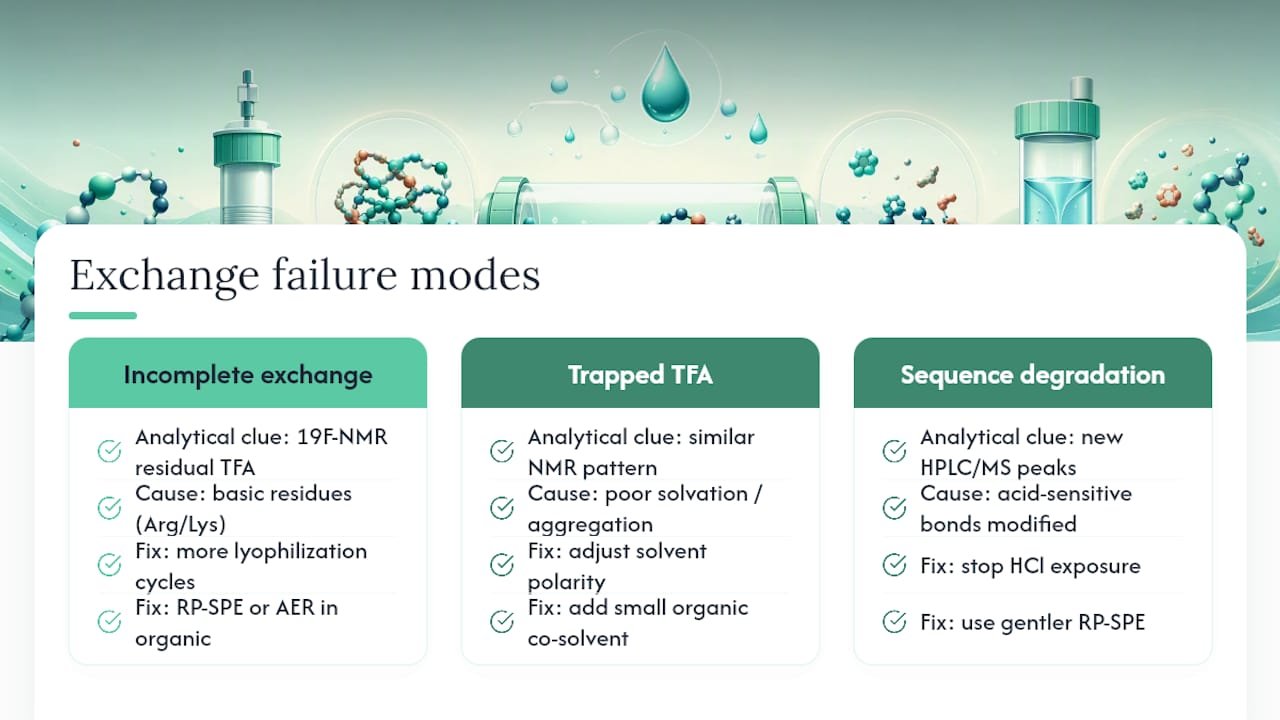
TFA trapped in aggregated or poorly solvated peptide looks similar on paper but behaves differently: the peptide simply never fully dissolves during the exchange step, so the counterion never gets the chance to exchange. Adjusting solvent polarity, adding a small proportion of organic co-solvent to the aqueous HCl, or pre-dissolving in a stronger solvent before dilution often solves this without needing an entirely different method.
Sequence degradation is the case you want to catch early. Acid exposure during exchange can cleave acid-labile bonds or modify sensitive residues in peptides that were never good candidates for aggressive HCl treatment in the first place. If HPLC/MS after exchange shows new peaks or mass shifts that were not there before, you are looking at degradation, not incomplete exchange, and the fix is to move to the gentler RP-SPE route rather than run more lyophilization cycles.
When standard reversed-phase chromatography gives ambiguous purity values, orthogonal methods help clarify what is actually happening. HILIC (hydrophilic interaction chromatography) or mixed-mode chromatography (MMC) can separate species that co-elute under standard RP conditions, and combined with MS confirmation this is the fastest way to tell counterion residues apart from a genuine sequence problem.
What to demand on a certificate of analysis before you buy
The fastest way to avoid in-house counterion exchange is to buy peptides whose salt form is already specified and verified. A trustworthy COA should state the salt form explicitly, not just “TFA salt (assumed)”, together with quantified residual counterion levels, HPLC purity and, for identity-critical work, mass-spectrometric identity confirmation.
Specifically, look for:
- Salt form stated by name, not inferred from the synthesis method.
- Residual TFA or other counterion levels quantified numerically, not described as “trace” or “minimal”.
- HPLC purity as a percentage, tied to a specific chromatographic method so you can judge what the number actually means.
- Mass-spectrometric confirmation, where identity is critical to your research question, that the peptide is the sequence you ordered, not just “pure by some measure”.
Verifiable batch testing matters here: a batch-specific COA with a disclosed method, full chromatogram and named testing lab can be checked, and an external second analysis adds a further safeguard. A supplier’s COA and lab-testing page that documents exactly how batches are verified, rather than asserting purity as a marketing claim, gives you something you can actually check before committing lab time or budget to a batch. Fast, reliable shipping from the EU also reduces the temptation to accept a less well-documented supplier just to save a week of lead time, a compromise more labs make than they would admit.
In short, supplier transparency about salt form lets you skip the whole counterion exchange workflow for peptides whose target anion already matches your assay requirements.
Where this field is heading
The clearest trend in recent peptide chemistry literature is convergence on combined RP-SPE workflows and lower HCl concentrations, essentially the field agreeing on “less, but more carefully” instead of aggressive acid treatment over many cycles. That is a good instinct. Gentler, better-characterised protocols beat brute-force approaches, especially for sequences with acid-sensitive residues that older high-concentration HCl methods would have quietly degraded without it showing up in a standard purity check.
What the field still gets wrong, in my view, is documentation discipline. Too many publications describe a peptide’s biological activity without stating its counterion, as if the salt form were incidental packaging rather than an active variable shaping the result. Given how markedly counterion identity can shift secondary structure and membrane behaviour, that omission deserves the same scrutiny reviewers already apply to solvent and pH reporting.
The next real advances are likely to come from faster exchange techniques in organic media and cheaper, more accessible trace analytics, so that smaller labs without NMR access can verify their own work instead of relying on a vendor’s word.
— Max
Where to get peptides with the counterion already handled
If all of this sounds like more lab time than your project allows, that is exactly the gap a supplier with batch-specific certificates of analysis for purity can narrow: you start from a documented purity baseline and can ask about the salt form before ordering rather than guessing at it.

Peptelia’s product quality and testing page sets out exactly how batches are verified before they reach a customer, and that is the kind of documentation you should check against any supplier’s claims, ours included. For neurocognitive research, the product pages for the neuropeptides Semax and Selank show what a batch-specific COA looks like in practice. Shipping from the EU is fast, so a verified batch does not mean a long wait. Before your next order, it is worth browsing the current product range and comparing the COA with what your current supplier is willing to show.
Sources
- Towards a Consensus for the Analysis and Exchange of TFA as a Counterion in Synthetic Peptides and Its Influence on Membrane Permeation
- The Effects of Counter-Ions on Peptide Structure, Activity, and Applications
- A New Methodology for Synthetic Peptides Purification and Counterion Exchange in One Step Using Solid-Phase Extraction Chromatography
- Anion-exchange resin (AER) methods applied to halide-for-anion exchange in organic media
FAQ
What is peptide counterion exchange?
It is the process of replacing the counterion left over from peptide synthesis, usually trifluoroacetate, with a target anion such as chloride or acetate, in order to reduce assay interference and adjust structural or formulation properties.
What concentration of HCl is best for counterion exchange?
A systematic study across several peptides identified 10 mM HCl as the optimal lyophilization concentration, bringing residual TFA below the limit of detection without compromising purity.
How do you confirm a counterion exchange worked?
19F-NMR is the primary method for quantifying residual TFA, supported by HPLC-ELSD and FT-IR as complementary checks according to validated analytical protocols.
Why does TFA interfere with mass spectrometry?
TFA suppresses ionisation efficiency in positive electrospray mode, making the MS signal weaker and noisier than for the same peptide as an acetate or chloride.
Is RP-SPE better than lyophilization for counterion exchange?
RP-SPE combines purification and exchange in a single step, delivers 82 to 97 percent purity with low residual TFA and is generally faster with less solvent waste than repeated HCl lyophilization cycles, although lyophilization remains simpler for labs without SPE equipment.
Can I avoid counterion exchange entirely?
Yes, by sourcing peptides from a supplier whose COA already states the salt form, residual counterion levels and HPLC purity, which makes in-lab exchange unnecessary for peptides that already match the target anion.





