

For procurement purposes, a peptide quality agreement means the supplier includes a batch-specific certificate of analysis (COA) with every order, and that COA reports an HPLC chromatogram with a disclosed method, a named testing lab and a batch number that matches the vial. Without these elements, the batch should be treated as unverified. Mass spectrometric identity confirmation is required wherever the work is identity-critical, endotoxin data become essential the moment the material comes into contact with cell culture or receptor work, and net peptide content (NPC) becomes mandatory the moment the dosing calculation depends on how much actual peptide is in the vial.
TL;DR:
- Peptide COAs should include an HPLC chromatogram, the disclosed method and a named testing lab; mass spectrometric identity, net peptide content and endotoxin results are required where the research question calls for them.
- Chromatograms should be checked carefully for shoulders, baseline noise and detector saturation, as these artefacts frequently inflate purity claims.
- For high-stakes experiments, check batch details when ordering, match batch numbers on receipt and retain reserve samples for possible independent testing.
- Endotoxin limits range from below 1 EU/mg for cell culture to below 0.1 EU/mg for sensitive immunoassays and require thorough documentation.
- For trustworthy peptide sourcing, rely on batch-specific COAs issued at the time of shipment with detailed analytical data, not on generic data sheets or unattributed purity percentages.
Table of contents
- What a COA should include and why each element matters
- How to read chromatograms and mass spectra on a COA
- COA acceptance checklist and minimum thresholds by application
- Procurement and verification workflow, from order to independent testing
- Peptélia’s approach to batch transparency
- Get COA-verified peptides for your next study
- Sources
What a COA should include and why each element matters
HPLC purity is an area-percentage value measured at a specific UV wavelength, usually 214 to 220 nanometres. The number is only meaningful if the method is disclosed, because two laboratories using different columns and gradients can report different purity values for the same sample. Creative Proteomics’ guide to HPLC and LC-MS analysis puts it plainly: HPLC confirms purity, but only LC-MS confirms that the peptide you ordered is actually present.
A complete COA can contain these five components; which of them are required depends on the research question:
- HPLC chromatogram with integration table, so that shoulders, co-elution and the analyst’s baseline placement can be checked.
- Mass spectrometric identity, required for identity-critical work, confirming the intact mass and, ideally, MS/MS sequence coverage.
- Net peptide content (NPC) from amino acid analysis, accounting for counterions such as TFA or acetate as well as residual water.
- Endotoxin and residual solvent results, critical for any cell-based or in vivo protocol.
- Named testing laboratory, with accreditation status where the supplier can provide it.
PeptideGrades’ analysis of COA metrics finds that a large share of vendor COAs report HPLC purity only and omit NPC entirely, leaving the buyer to guess the actual concentration.
How to read chromatograms and mass spectra on a COA
A purity figure on its own says almost nothing. The chromatogram behind it shows whether that figure is real.
- Look for shoulders and clipped peaks. A shoulder on the main peak is often included in the integration and inflates the reported purity beyond what a careful analyst would call clean.
- Check the baseline. Excessive noise, or a baseline drawn to minimise the impurity area, is one of the most common ways purity gets overstated.
- Watch for detector saturation. A peak that runs off scale or is flattened at the top means the detector was at its limit, and any integration built on it is unreliable.
- Confirm the intact mass match. The measured mass in the MS trace should agree with the theoretical mass within a tight tolerance, typically a few tenths of a percent or better for small peptides.
- Check MS/MS coverage if provided. Fragment ion coverage across the sequence is stronger confirmation of identity than intact mass alone, since intact mass can match by coincidence for short sequences.
Pro tip: If a COA shows a suspiciously round purity figure such as exactly 99 % with no visible chromatogram, request the raw trace before preparing anything. A number without a picture behind it is not data, it is a claim.
Integration artefacts, not synthesis quality, cause most inflated purity claims. Shoulder peaks and baseline decisions are the usual suspects, which is why the chromatogram image matters more than the printed percentage.
COA acceptance checklist and minimum thresholds by application
Before a batch enters a protocol, confirm three traceability points: the batch number on the vial matches the batch number on the COA, the COA carries a legible analysis date, and a named laboratory appears on the document, ideally with ISO/IEC 17025 accreditation. Peptidedefinition’s guide to reading COAs rates missing batch traceability as one of the clearest signs that a supplier is cutting corners.
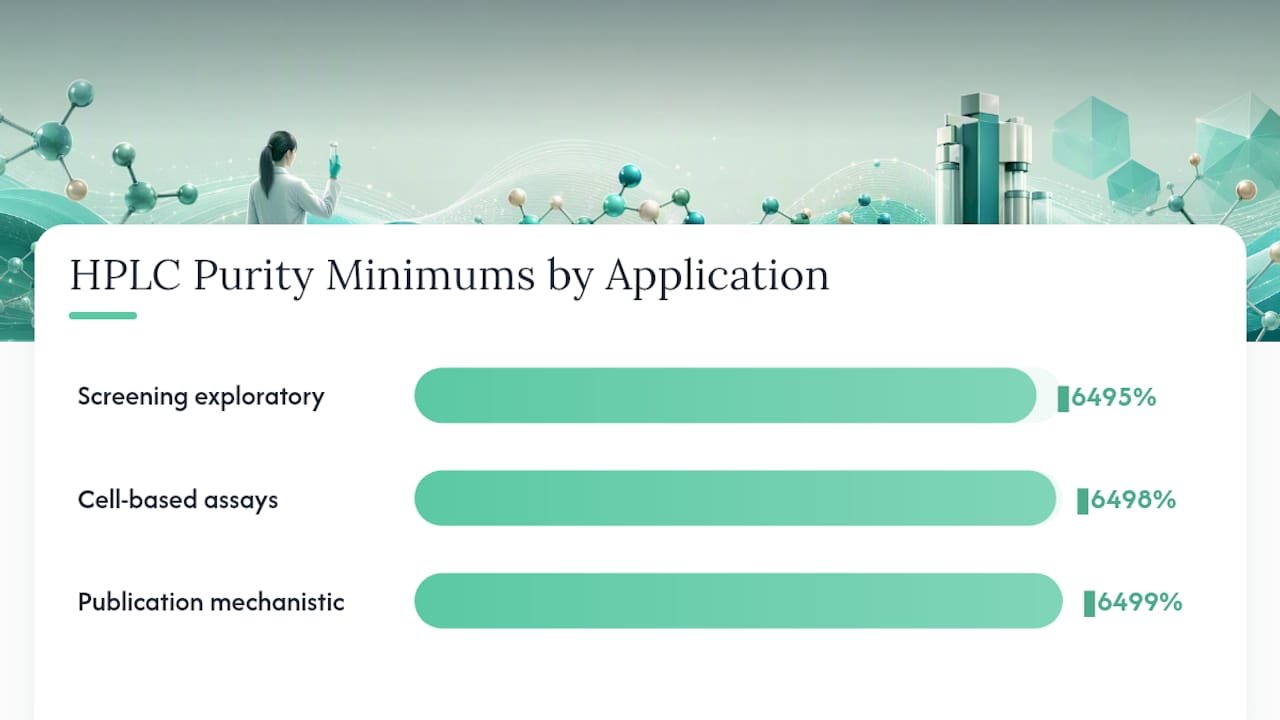
Acceptance thresholds should scale with the demands of the experiment:
- Screening or exploratory work: HPLC purity of 95 % or higher, chromatogram visible.
- Cell-based assays: HPLC purity of 98 % or higher, with NPC stated so that the dosing calculation is correct.
- Publication-grade or mechanistic studies: HPLC purity of 99 % or higher, NPC stated and MS/MS sequence coverage included.
Endotoxin limits matter as much as purity. General cell culture work typically requires below 1 EU/mg, while immunology assays that are sensitive to inflammatory contamination need below 0.1 EU/mg. The same caution applies to any protocol involving live cells, regardless of peptide class, because an endotoxin spike can distort a result just as much as a purity problem.
Four points should trigger automatic rejection: no chromatogram image anywhere in the document, no batch number, a COA that looks like a template reused across several different products, and a round purity claim with no method details at all. Compound Review’s breakdown of what purity figures actually mean is unequivocal here: an HPLC percentage without stated method parameters is not comparable between vendors and should not be treated as verified data.
Procurement and verification workflow, from order to independent testing
Request the batch-specific COA at the time of ordering, not after the vial arrives. Some suppliers issue a generic product-level COA rather than one tied to the exact batch delivered, and that gap is where a lot of confusion starts.
- Request documentation when ordering. Explicitly ask for the COA belonging to the exact batch being shipped, not a representative or historical one.
- Verify on receipt. Match the batch number printed on the vial against the batch number on the COA before the material goes into a freezer or a protocol.
- Retain a reserve sample. Keep a small reserve aliquot in the lab records alongside the COA. If a result looks odd months later, material is available for confirmatory testing.
- Request NPC when dosing precision matters. Amino acid analysis adds cost and turnaround time, but it is the only way to know the actual peptide mass behind the vial weight.
- Escalate to independent testing when the stakes are high. For sensitive assays, or before submitting a publication, sending a reserve sample to an ISO/IEC 17025-accredited laboratory for confirmatory HPLC, MS and endotoxin testing closes the loop.
Pro tip: Add the reserve-sample step to the lab’s standard operating procedure now, before you need it. The lab that can produce a sample and its matching COA six months after a questioned measurement is the lab that survives the audit.
Peptélia’s approach to batch transparency
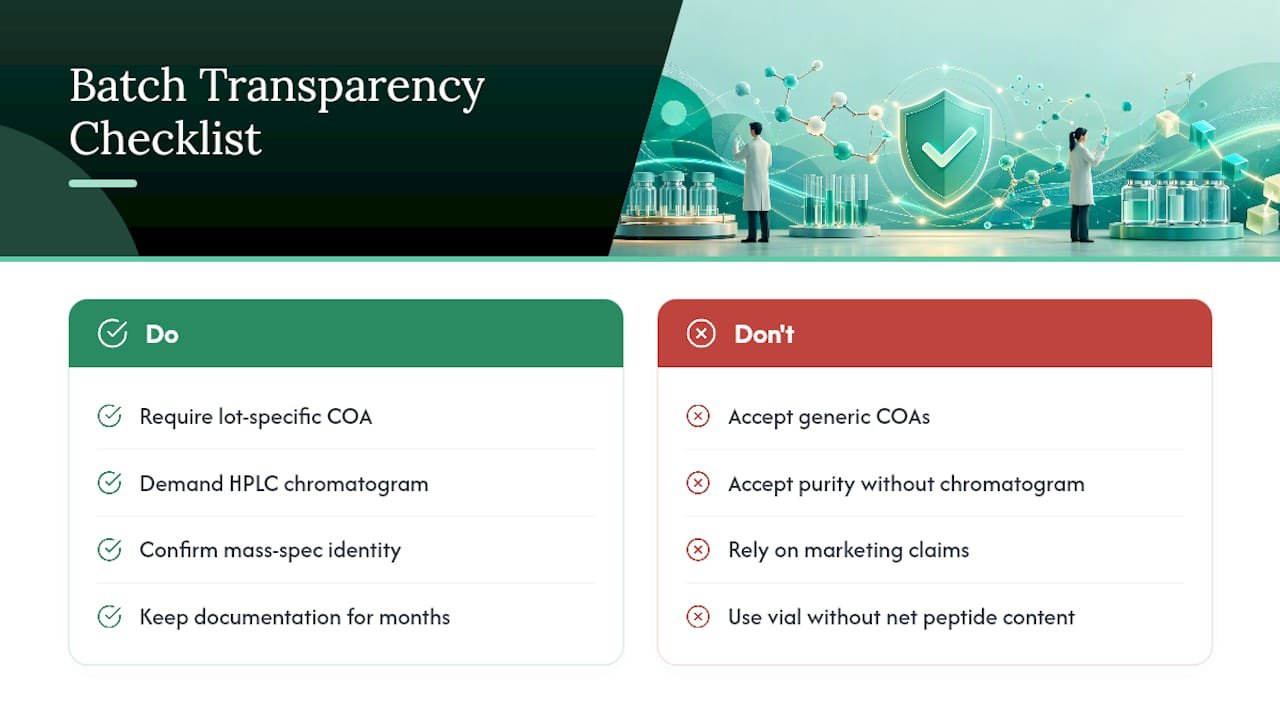
A batch-specific certificate of analysis should be issued with every order, tied to the specific batch shipped rather than to a generic product template. At Peptélia, every batch is tested in its own laboratory by HPLC and UV/Vis as standard, with mass spectrometry and endotoxin testing added depending on the product; on request, an additional second analysis by an external lab (Janoshik Analytical) is available.
Shipping should be fast and secure from within the EU, and documentation should remain available for labs that need to match a reserve sample against the records months after a study begins. Researchers in metabolic, regenerative, neurocognitive and cellular work face the same basic problem: a purity figure without a chromatogram cannot be verified, and a vial without NPC cannot be dosed with confidence. A quality agreement built on batch-level documentation rather than marketing claims is the only version of “quality” that holds up when a reviewer asks how you know the material was clean.
— Max
Get COA-verified peptides for your next study
Peptides should ship with a batch-specific COA so that nobody has to reconstruct purity claims from a generic data sheet. The product quality and testing page explains how each batch is tested and which analyses are added depending on the product.

When sourcing for neurocognitive research, the product page for the research peptide Selank shows how a batch-specific COA is tied directly to the product ordered rather than to a historical average. If you have questions about the documentation for a specific protocol, ask before ordering; on request, an additional second analysis by an external lab (Janoshik Analytical) is available.





