
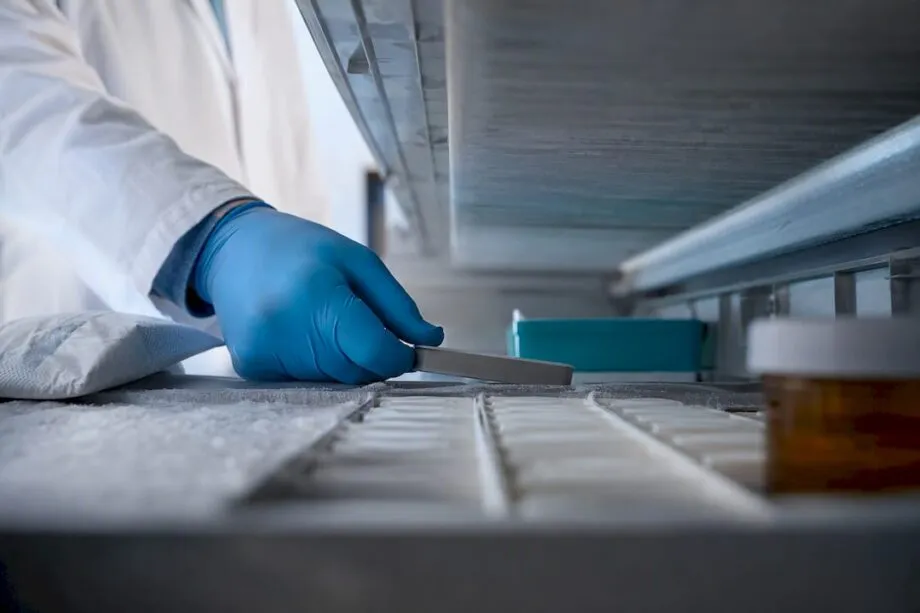
Lyophilised peptides should be stored dry, sealed and protected from light at −20 °C or colder for long-term stability; brief holding periods at 4 °C are fine for days to weeks. Peptide solutions should be aliquoted, kept at pH 5–6, frozen at −20 °C or below and never refrozen once thawed. Protect vials from light and moisture, and check the certificate of analysis (COA) before deviating from these defaults. The sections below cover sequence-specific risks and the exact handling steps.
TL;DR:
- Peptides in dry powder form should be stored at −20 °C or colder for maximum stability; short-term storage at 4 °C is acceptable for days or weeks.
- Reconstituted peptide solutions must be aliquoted immediately, stored at −20 °C or below and never refrozen after thawing, to prevent degradation.
- Peptides with oxidation-prone residues such as cysteine, methionine or tryptophan need an inert gas overlay during storage to prevent oxidation and preserve stability.
- Storage containers should be low-binding; use amber glass or opaque wrapping for light-sensitive peptides. Avoid frost-free freezers because of their temperature fluctuations.
- Following the certificate of analysis, correct handling and environmental controls are essential to prevent sequence-specific degradation and preserve peptide integrity.
Table of contents
- Storage for lyophilised (dry) peptides
- Storage for peptides in solution
- Reconstitution and handling best practices
- What actually drives peptide instability
- A practical storage and handling workflow
- Choosing the right containers and freezers
- The standards behind these recommendations
- What Peptélia checks before a peptide ever ships
- Order with storage risk already handled
- What most storage advice gets backwards
- Sources
Storage for lyophilised (dry) peptides
Dry peptide powder is the most stable form you will work with in the lab, and −20 °C or colder is the standard recommendation for long-term storage. A refrigerator at 4 °C is acceptable for short holding periods – days to a few weeks – but it is not where a vial should sit for months. The bigger risk at this stage is usually not temperature but moisture and oxygen finding their way into the vial.
Practical rules that actually prevent degradation:
- Keep desiccant in the storage container at all times, not just on receipt.
- Let sealed vials equilibrate to room temperature in a desiccator before opening them, because opening a cold vial invites condensation directly onto the peptide.
- Reseal vials tightly and promptly after every sampling.
- Flush the headspace with nitrogen or argon for peptides containing cysteine, methionine or tryptophan, since oxidation-prone residues benefit from an inert atmosphere.
- Always check the manufacturer’s certificate of analysis for peptide-specific storage guidance before assuming the generic rule applies.
Pro tip: If a peptide’s sequence contains two or more oxidation-prone residues, treat argon overlay as a standard step, not an optional one. The cost of an argon cylinder is negligible compared with a ruined batch of research material.
Storage for peptides in solution
Once a peptide is reconstituted, the clock starts ticking. Solutions degrade faster than dry powder through hydrolysis, oxidation and microbial contamination, which is why Bachem’s handling guidelines recommend buffering solutions to around pH 5 to 6, a range that minimises both acid-catalysed hydrolysis and base-driven deamidation for most sequences.
Once a peptide is in solution, follow this sequence:
- Aliquot immediately after reconstitution into volumes sized for single experiments, not multi-day dosing schedules.
- Freeze aliquots at −20 °C for short-term work; anything to be stored for longer than a few weeks belongs at −80 °C.
- Never refreeze a thawed aliquot. Freeze–thaw cycles are among the most consistently cited causes of peptide loss in supplier and laboratory guidance.
- Sterile-filter through a 0.2-micron filter if storage in solution beyond one or two days is unavoidable, because bacterial contamination breaks down peptides just as effectively as chemistry does.
The maths is simple: an aliquoting plan matched to your actual experimental rhythm costs a few extra tubes up front and saves an entire batch later.
Reconstitution and handling best practices
A lot of peptide is lost during reconstitution, before an experiment even starts. First bring the vial to room temperature in a desiccator. If a cold vial is opened in ambient air, moisture condenses directly onto the powder, and that moisture starts hydrolysis before a single microlitre of solvent has been added.
Weigh out the material quickly and close the stock vial tightly afterwards. Start reconstitution at a higher concentration than you ultimately need. Sterile water or 0.1% acetic acid works for most peptides; for hydrophobic sequences that dissolve poorly, escalate step by step – first a small volume of dilute acetic acid, then a minimal amount of DMSO or acetonitrile if needed – rather than going straight to a strong organic solvent.
A few measures that reduce losses in practice:
- Use low-adsorption or low-binding vials instead of standard polystyrene.
- Keep working solutions at higher concentrations where possible, because dilute peptide solutions lose far more material to adsorption on the vial wall than concentrated ones.
- After transferring the solution, rinse vials with a small volume of buffer to recover material sticking to the walls.
Pro tip: Before reaching for a stronger solvent, try gentle sonication. A brief sonication step often dissolves a stubborn peptide completely, without the adsorption or denaturation risk that comes with more aggressive organic solvents.
What actually drives peptide instability
Some sequences are simply sensitive. Cysteine, methionine, tryptophan, asparagine and glutamine residues carry an elevated risk of oxidation and deamidation, and a peptide with several of these residues needs stricter handling than one built from more stable residues.
Environmental accelerators amplify sequence risk. Light exposure drives oxidative breakdown of vulnerable residues, which is why amber glass vials or opaque secondary packaging matter more than most researchers assume. Moisture uptake accelerates hydrolysis in dry powder. Oxygen exposure and pH extremes both push degradation in solution along faster.
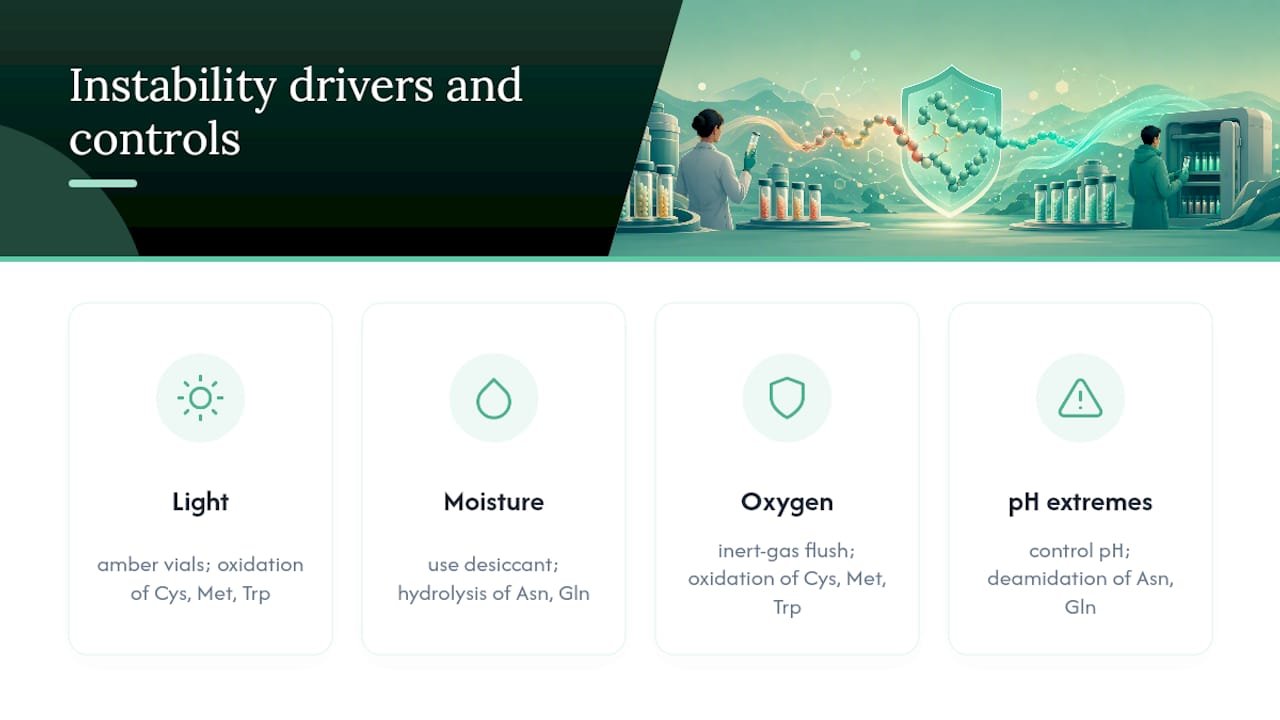
There is also a concentration effect that surprises many people: at low concentrations, a significant fraction of the peptide can simply stick to the container wall instead of staying in solution, an effect that grows the more dilute the working solution is and the longer it stands before use.
A practical storage and handling workflow
A repeatable workflow beats memory every time. Inspect the shipment as soon as it arrives.
- Match the certificate of analysis against the batch number on the vial and record both, together with the manufacturer’s recommended storage temperature.
- Move the vial into its designated cold storage straight away rather than leaving it on the bench “for a moment” while you finish another task.
- When reconstituting, aliquot into single-use volumes labelled with peptide name, concentration, buffer and date.
- Thaw aliquots slowly and keep vials closed until they reach working temperature, because opening a cold vial causes the same condensation problem as with dry powder.
- For transport between labs or long shipping routes, use dry ice for peptides that require deep-frozen storage and insulated cold packs for shorter transfers in the refrigerated range.
The habit that separates careful labs from careless ones is not sophisticated. It is simply refusing to leave a vial at room temperature “for a few minutes” more than once.
Choosing the right containers and freezers
Container material matters more than most protocols admit. Glass is chemically inert and standard for many applications, but some peptides adsorb to untreated glass surfaces. Specially treated polypropylene, marketed as low-binding or low-adsorption, often performs better for dilute working solutions.
The choice of freezer is just as important:
- Avoid frost-free domestic freezers for anything beyond short-term storage, because their automatic defrost cycles create temperature swings that accelerate chemical degradation over repeated cycles.
- For long-term storage of dry powder and solutions, use a temperature-stable manual-defrost freezer or an ultra-low freezer.
- Keep desiccators on hand for equilibrating vials, and use amber glass or opaque wrapping for any peptide known to be light-sensitive.
The standards behind these recommendations
None of these practices are guesswork. They trace back to published consensus guidance and regulatory frameworks that labs can consult directly.
- Proteomics researchers have called for harmonised sourcing, characterisation and storage practices, because sequence-dependent instability means no single rule fits every peptide.
- The ICH Q5C guideline on stability testing of biotechnological/biological products provides the regulatory logic behind designing stability protocols and documenting storage conditions, including for research material outside formal drug development.
- Storage data published by the supplier, such as that found on a certificate of analysis, should override generic temperature rules whenever the two conflict.
Translated into daily practice, this means documentation is not paperwork for its own sake. It is the mechanism that lets you trace a stability problem back to a specific batch, a temperature excursion or a handling step.
What Peptélia checks before a peptide ever ships
Every batch is tested in Peptélia’s own laboratory by HPLC and UV/Vis and receives a batch-specific COA; on request, an additional second analysis by an external lab (Janoshik Analytical) is available. Orders ship quickly and securely from the EU, with dispatch on the next business day.
Order with storage risk already handled
Everything in this guide assumes you start with a peptide that was pure and stable the moment it left the manufacturer. That is the part most storage advice skips, and it is the part that decides whether your careful desiccator routine is protecting real material or merely delaying the inevitable. Peptélia tests every batch in its own laboratory and ships every order with a batch-specific certificate of analysis confirming over 99% purity, so you know exactly what you are storing before it ever reaches the freezer.

Fast, secure shipping from the EU means less time in transit, where temperature control is out of your hands, and more time in your own controlled storage. Whether you are running neurocognitive research with Selank, metabolic studies with our bundled research kits or sourcing copper peptide for regenerative work, every product page lists the batch-specific purity data you need to plan your storage protocol before the vial arrives. Browse the full catalogue and review each product’s COA before you order.
What most storage advice gets backwards
Most peptide storage advice treats temperature as the whole story. It is not. Freezers matter, but the sequence you are storing tells you more about the risk than the thermometer does. A peptide without cysteine, methionine or tryptophan and with a clean, simple structure tolerates more handling variation than one packed with oxidation-prone residues, and treating both the same is where many labs waste money on unnecessary ultra-low freezer space – or, worse, lose material they believed was stable.
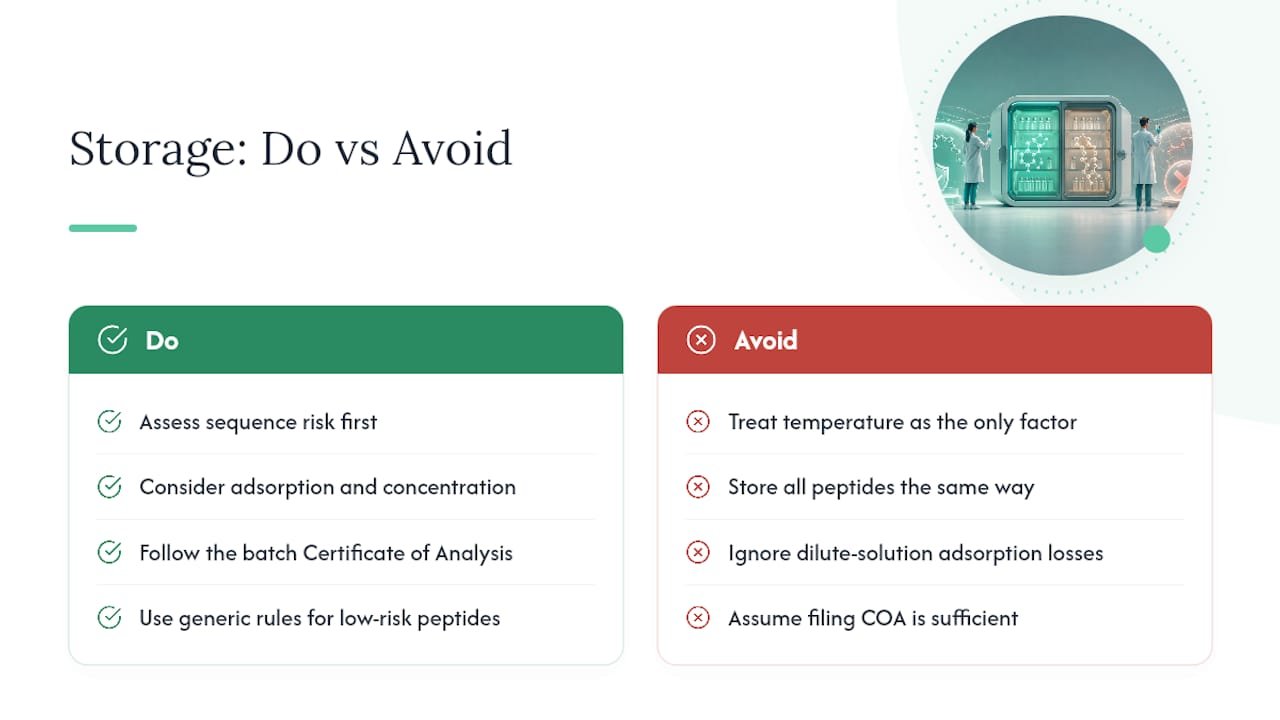
The other blind spot is adsorption. Researchers fixate on temperature fluctuations and forget that a dilute working solution can lose a significant share of its peptide to the vial wall before anyone notices a problem in the data. That is not a freezer problem. It is a concentration and container problem, and no amount of cold storage will fix it.
If there is one habit that belongs in every SOP, it is treating the certificate of analysis as a working document, not a filing formality. The generic rules in this guide hold up for the vast majority of peptides. But when the documentation for a specific batch says something different, the documentation wins.
— Max
Sources
- Peptide Handling, dissolution & Storage — NIBSC
- Handling and storage guidelines for peptides — Bachem
- Peptide Storage: Are You Getting the Best Return on Your Investment? — Journal of Proteome Research
- Q5C guideline — ICH





